Most business owners think SEO is all about keywords, backlinks, and content.
You pick a few keywords, write a few blog posts, maybe get a few links and you wait for traffic to grow.
But here’s the truth: even if your content is genuinely good, if your website has hidden technical problems, Google won’t rank it the way it could.
I see this all the time when I run SEO audits for clients (and I’ve done over 300!): the business has a strong offer, clear services, and a credible brand, yet something small “under the hood” quietly blocks Google from crawling, indexing, or understanding the site properly.
Let’s Make Your SEO & Content Work Better for Your Business
In this guide, I’m going to show you how to audit a website for SEO step by step and provide you with an SEO audit checklist, the same structured process professional agencies use when delivering high-level audits. You’ll learn how to find what’s hurting rankings, what to fix first, and how to turn your audit into a clear growth plan instead of a confusing list of issues.
By the end, you should be able to look at your site and understand it the way Google sees it and that’s the real advantage of doing a complete SEO audit properly.
Your Traffic Drop Probably Isn’t Random
Most ranking losses come from overlooked SEO issues. Download my Complete SEO Audit Checklist to quickly identify what’s broken, what’s underperforming, and what to fix first to regain visibility.
You have Successfully Subscribed!
Diagnosis Before Treatment
Let’s say you wake up one morning and your car won’t start.
You probably wouldn’t start replacing random parts. You wouldn’t change the tires, then the radio, then the steering wheel, hoping the engine comes back to life. You’d check the battery. You’d check fuel. You might run a diagnostic scan or call a mechanic who can identify the real cause.
And yet, most businesses do the opposite with SEO.
When rankings drop, they publish more content, chase new keywords, tweak headlines, or even buy backlinks without confirming why traffic dropped in the first place. That’s the SEO version of treating symptoms without running tests.
An SEO audit is your diagnostic scan. It tells you what’s healthy, what’s weak, and what’s silently hurting performance. When you understand that, every improvement you make becomes intentional, prioritized, and measurable, not a random effort.
So we’ll go layer by layer, from the structure of your site to its credibility, and by the end, you’ll know how to turn a website from invisible to visible using a complete SEO audit framework.
If your website is the body of your business, technical SEO is its heartbeat. This is the layer where you confirm whether Google can crawl your pages efficiently, load them fast enough, and understand the structure well enough to trust what it finds.
A lot of websites fail here without realizing it, because technical issues don’t always “look” like issues. Pages load. The design looks fine. Leads still come in sometimes. But rankings stagnate because Google encounters friction: blocked crawling, messy redirects, thin internal pathways, slow templates, or inconsistent directives.
Step 1: Crawlability and indexing
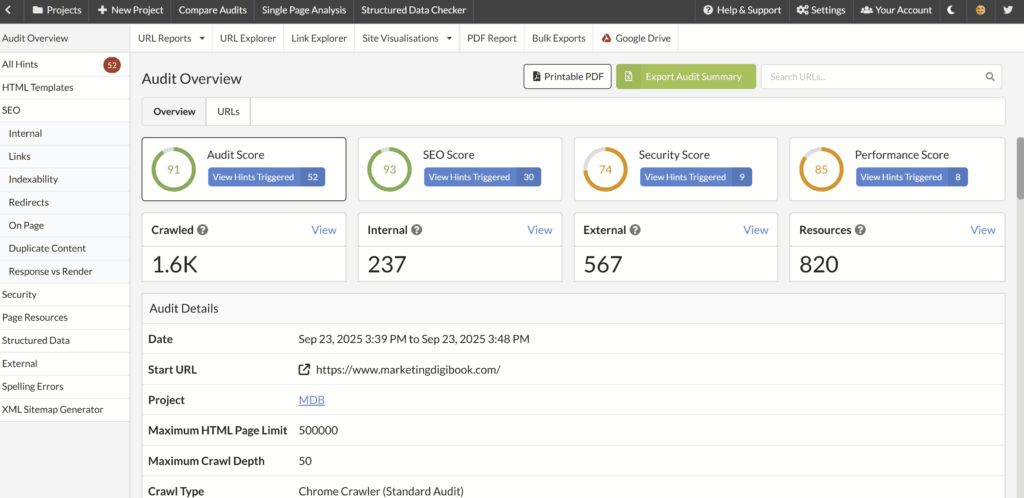
Start by crawling your website using a tool that emulates a search engine crawl, such as Screaming Frog or Sitebulb. Think of this as Google’s stethoscope: it scans the site the way a search engine does and shows what’s reachable, what’s broken, and what’s structurally confusing.
When you crawl, you’re looking for issues that prevent Google from discovering and processing your pages properly, including:
Blocked URLs (for example, pages you want indexed that are accidentally noindex or disallowed).
Redirect loops (URL A redirects to URL B, which redirects back to URL A).
Long redirect chains (URL A → B → C → D) that waste crawl budget and dilute signals.
Orphan pages (pages that exist but have no internal links pointing to them).
Unexpected canonical tags that point to the wrong version of a page.
A useful way to picture this is the “delivery driver” metaphor: consider Google a delivery driver trying to deliver your content to search results. If your internal roads are broken, if signs are missing, or if the map is contradictory, Google can’t reliably deliver your content.
This step often reveals the difference between a site that “has content” and a site that is actually crawlable at scale.
Step 2: Sitemaps and robots.txt
Next, confirm your sitemap and robots.txt rules are aligned.
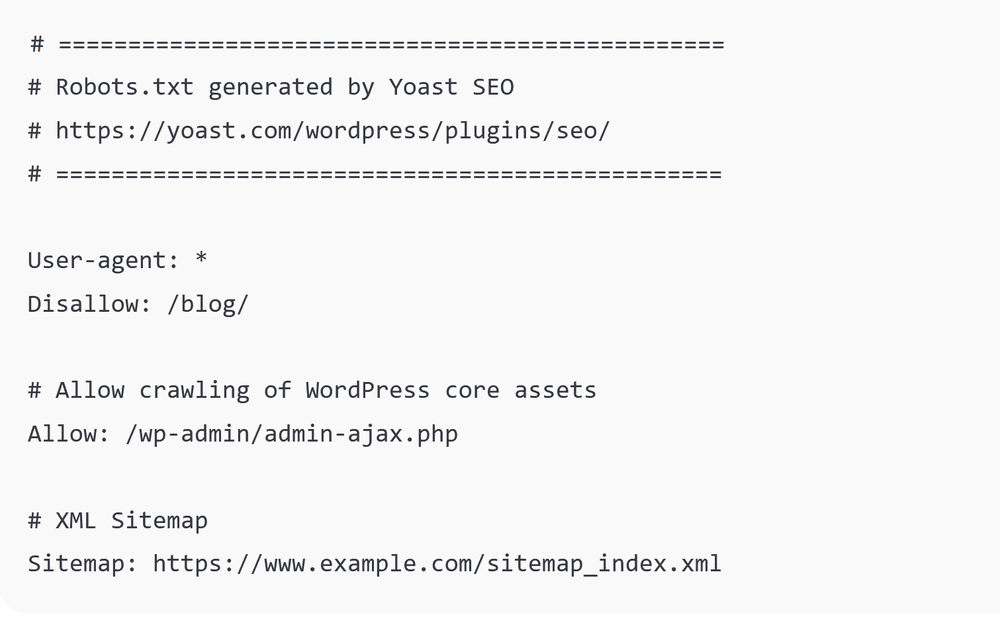
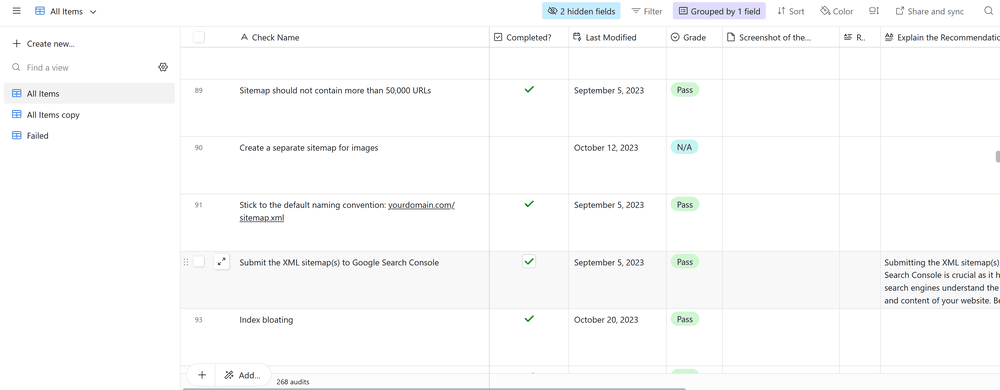
Your XML sitemap tells Google where everything is. Your robots.txt file tells Google where not to go. If either is missing, outdated, or misconfigured, it can silently block entire sections of your website.
A surprisingly common issue is a site accidentally blocking its most important pages. For example, I’ve seen businesses block their /services/ section or their /blog/ folder and then wonder why nothing ranks, because the site still “works” for users, but Google receives instructions not to crawl.
You want a situation where your sitemap contains your indexable pages (not everything, only what should rank), and robots.txt does not block those areas. You also want to confirm that the sitemap is actually accessible, correctly formatted, and submitted in Search Console.
SEO Audit Checklist – Step 3: Broken links and 404s
Now scan for broken links and 404 errors.
Broken links do two things at once: they create a poor user experience (visitors hit dead ends), and they waste crawl resources (Google follows links that lead nowhere). Over time, this creates a site that feels less “maintained,” which can weaken overall trust and crawl efficiency.
When you find 404s, handle them strategically:
If the page should exist, restore it or fix the link. If it was moved, use a clean 301 redirect to the best relevant replacement. If it should not exist anymore, make sure you remove internal links pointing to it, so you stop sending both users and Google into a closed door.
Step 4: Page speed and Core Web Vitals
Speed is not just about “SEO points.” It’s about user experience, and user experience affects performance. A site that loads quickly holds attention. A site that takes too long loses visitors before they even see the value.
Use Google PageSpeed Insights or Lighthouse to test key templates especially:
Your homepage.
Your main service pages.
Your blog template (because blog traffic is often the primary acquisition channel).
As a general benchmark, aim for a performance score above 80 on mobile and desktop, understanding that different sites have different constraints, but the principle is stable: faster is almost always better.
If your scores are low, the most common fixes are usually not mysterious:
You compress and resize images properly. You reduce heavy scripts and third-party trackers where possible. You enable caching correctly. You minimize render-blocking resources. In some cases, you invest in better hosting because infrastructure is the bottleneck.
Speed is often the “vital sign” that tells you whether your SEO efforts will compound or leak.
Step 5: Mobile SEO audit
Google indexes mobile first, which means your mobile site is the site Google evaluates as primary. That fact alone makes mobile usability non-negotiable, even if your audience is mostly desktop, because the crawler and indexation systems rely heavily on the mobile version.
Check your site on your phone like a real user:
Is the text easy to read without zooming? Are buttons comfortably clickable? Do forms work smoothly? Does the page load in under three seconds on a typical mobile connection?
If the answer is no, you start here, because mobile usability affects rankings and conversions at the same time.
A slow, unresponsive website is like a patient struggling to breathe — no other treatment will matter until that’s fixed.
Your Traffic Drop Probably Isn’t Random
Most ranking losses come from overlooked SEO issues. Download my Complete SEO Audit Checklist to quickly identify what’s broken, what’s underperforming, and what to fix first to regain visibility.
Once the structure is healthy, you audit the “brain”: your content, your on-page signals, and the clarity of topical relevance.
This is where Google decides whether you’re an expert, a generalist, or simply not the best result.
The content audit is not just “is it written well.” It’s whether the site communicates expertise consistently, whether pages match search intent, and whether Google can understand how your pieces connect into a coherent topical map.
Step 1: Check for thin or outdated content
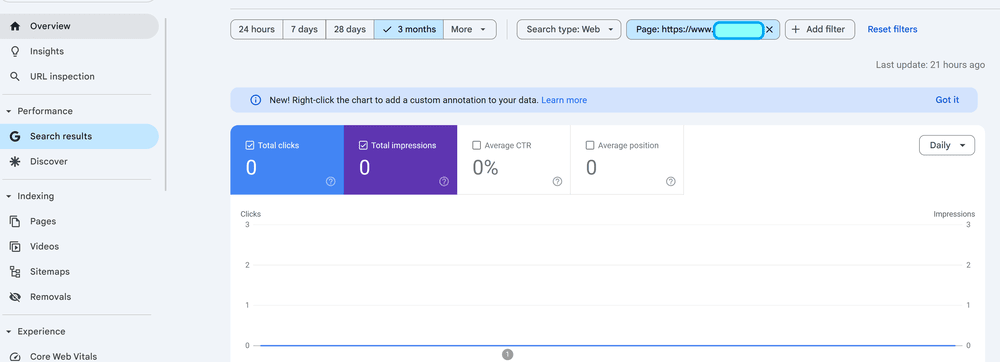
Start in Google Search Console and identify pages that get zero impressions or almost no clicks. These are not always “bad” pages, but they often indicate that the page is either targeting the wrong intent, lacks depth, or is not supported internally.
A common example is a services page that is too short. If your “Services” page has a few sentences and a contact form, it may not be enough in competitive spaces. Strengthen it with benefits, FAQs, process steps, pricing context (even if you don’t publish exact prices), testimonials, or examples that reduce buyer hesitation and increase relevance.
Another example is a blog post that was accurate two years ago but lacks updated context, updated screenshots, or new angles that competitors now include. Content decay is real: pages don’t always “fall” because they became worse; they fall because competitors became better, and search intent became more demanding.
Step 2: Detect duplicates and keyword cannibalization
Use Semrush or Ahrefs to find pages competing for the same topic. Keyword cannibalization happens when multiple URLs target the same or very similar intent, so Google has to choose which one deserves ranking — and sometimes it chooses none strongly.
The script example is perfect: if you have three blog posts about “How to Choose a Divorce Lawyer,” Google may not know which one is the best answer. The solution is usually consolidation: merge them into one comprehensive guide, redirect old URLs where needed, and make the merged page clearly superior.
Cannibalization is not “more content equals more rankings.” Often, fewer pages with stronger depth equals more stability.
Step 3: Internal linking structure
Internal links are how Google discovers what matters and how topics relate. Imagine Google as a reader following clues. If a page isn’t linked from anywhere, it’s effectively invisible.
In a healthy architecture, every important page is reachable in three clicks or less, and supporting blog content links to core service pages in context (not spammy, not forced – naturally, when it makes sense).
Internal linking does two strategic jobs:
It distributes authority from high-performing pages to pages that need help. And it tells Google what the site is “about” by reinforcing topical relationships.
Step 4: Topical clusters
Topical clusters are the structure that turns a blog into an authority hub.
A cluster starts with a broad pillar topic and branches into supporting subtopics. The law firm example captures this well:
If your main topic is “Family Law,” supporting pages could cover “Divorce,” “Child Custody,” “Child Adoption,” “Prenuptial Agreements,” and more and those pages should link to each other strategically.
This structure helps Google understand you’re not publishing random articles; you are building expertise in a defined area.
Content SEO Audit Checklist – Step 5: On-page optimization
Now review your page titles, H1 headings, and meta descriptions.
This is where many sites leave easy wins on the table. A title like “Services | Johnson Law Firm” tells Google almost nothing about what you offer and tells users almost nothing about why they should click.
Compare that to: “Family Law & Divorce Services | Johnson Law Firm – Expert Legal Help You Can Trust.” This includes the topic, aligns with intent, and communicates value.
Your goal is not to stuff keywords. Your goal is clarity: “What is this page about, and why is it the best result?”
Step 6: NLP and semantic relevance
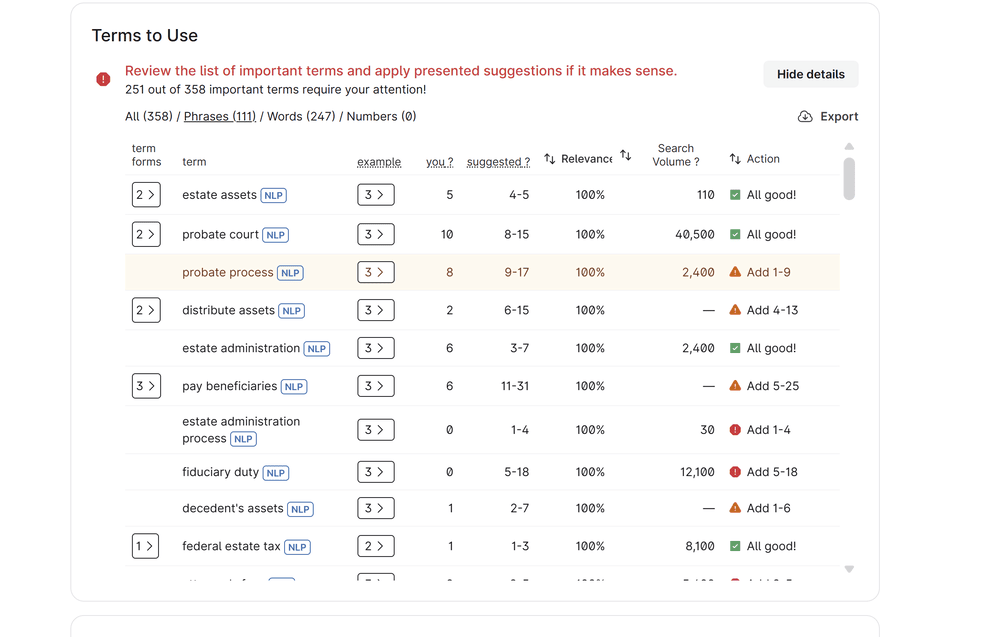
Modern search systems evaluate semantic completeness. Tools like SurferSEO, Neuronwriter, or Clearscope help you identify whether your content covers the terms, entities, and related concepts that the topic expects.
The script makes the point clearly: if your article about “SEO audits” never mentions “indexing,” “backlinks,” or “page speed,” it’s incomplete in Google’s eyes.
This does not mean you add keywords randomly. It means you cover the real subtopics a user expects when they search — so the page feels complete, trustworthy, and useful.
Your content is like your brain’s communication: if it’s fuzzy, inconsistent, or repetitive, Google can’t understand what you’re trying to say.
3) International SEO Audit — Speaking the right language
If your business serves multiple regions or languages, international SEO becomes a separate layer of risk and opportunity.
International SEO is not simply translation. It is making sure search engines serve the correct version to the correct audience and that each version is strong enough to rank in its own market.
Hreflang tags
Hreflang tells Google which language and country version of your content to show. Without hreflang, Google may guess incorrectly.
That can create problems like users in Germany seeing the English page, or users in the UK seeing a page meant for the US. Even worse, it can cause the wrong version to rank, which weakens conversions because the content doesn’t match language expectations.
Localized URLs
Use clean structures like country-specific subfolders: for example “/de/” for German and “/fr/” for French.
Avoid auto-translations because they confuse users and Google. Machine translation can be a starting point for internal drafts, but publishing unedited auto-translations as your international strategy often harms credibility and performance.
Consistent metadata
Translate titles and meta descriptions properly, not word-for-word. Keywords differ across languages in how people search.
The example matters: “Wedding Rings” in English might be searched as “Trauringe” in German. That is not a translation choice; it is a search behavior reality.
Interlink language versions
International sites should always make it easy for users and search engines to switch between language versions. Make sure each page points to its equivalents.
If hreflang tags are wrong, it’s like sending the right medicine to the wrong patient — your message lands in the wrong country.
4) Local SEO Audit — Your neighborhood check-up
For local businesses, SEO success starts where people live and search. Queries like “dentist near me” or “plumber in Berlin” rely heavily on local signals and trust indicators.
Local SEO is not just about ranking; it is about being the obvious, credible option in a geographic market.
Step 1: Google Business Profile
Claim and optimize your listing. Add real photos, correct categories, working hours, and posts. Keep the description consistent and specific.
A Google Business Profile is often the first thing a local prospect sees. If it’s incomplete, inconsistent, or outdated, it weakens both rankings and conversion confidence.
Step 2: NAP consistency
Your business name, address, and phone number should be identical across directories — Yelp, Bing, Apple Maps, industry directories, and local listings.
Even small variations, like “St.” versus “Street,” can cause confusion at scale. You’re not just trying to “appear.” You’re trying to appear consistently.
Step 3: Local schema markup
Add LocalBusiness structured data so Google can interpret your location, contact info, and reviews more reliably.
Schema won’t magically fix weak content, but it reduces ambiguity and improves how your information is processed.
Step 4: Location-specific pages
If you serve multiple cities, create unique pages for each one. Avoid copy-paste city pages with swapped names. Instead, include city-specific testimonials, local context, and relevant imagery.
Local pages should feel real and tailored, because local intent is high-intent and sensitive to trust.
Step 5: Reviews and reputation
Encourage real reviews on Google and respond to them. A steady flow of positive reviews is one of the strongest local ranking factors and it also influences whether a prospect chooses you.
Your local SEO is your reputation in the neighborhood; if your address or reviews are inconsistent, customers simply go next door.
5) EEAT Audit — Building trust and professional credibility
Once you’ve built structure and visibility, you need trust.
EEAT (Experience, Expertise, Authoritativeness, and Trustworthiness) is how Google decides whether to believe you — especially in sensitive niches, competitive markets, and topics where accuracy matters.
This is not abstract. EEAT shows up in tangible site elements.
Step 1: Author transparency
Every major article should have a visible author bio, ideally with credentials or a link to a real profile (for example, LinkedIn).
Anonymous content is not “wrong,” but it is often less competitive, because it lacks the signals that show accountability and experience.
Step 2: Company information
Have a complete About page, Contact page, and visible legal policies (privacy policy, terms where relevant). Google uses these signals to verify legitimacy and reduce risk.
Trust is not built only through words. It is built through presence and transparency.
Step 3: Expert mentions
If your business has been featured in industry sites, associations, podcasts, conferences, or reputable directories, showcase it. Add “as seen in” references where accurate. Mentions from credible sources reinforce authority.
Step 4: Testimonials and reviews
Showcase real feedback and results, because it reduces buyer uncertainty and provides credibility signals.
The script example illustrates how a testimonial can communicate value quickly:
“After working with Lorraine, our traffic grew 280% in six months and we finally started getting consistent leads.”
Testimonials are not just conversion tools. They are trust assets.
Step 5: Security and privacy
Use HTTPS, display trust indicators appropriately, and keep privacy policies up to date. If you collect data through forms, make compliance visible.
EEAT is like your professional license — it tells both Google and your audience that you’re qualified, reliable, and real.
6) Backlink & Negative SEO Audit — The reputation test
Even if everything on your site is perfect, toxic backlinks can pull your rankings down.
Think of backlinks as external endorsements. High-quality links from relevant sources strengthen authority. Spammy links from irrelevant or harmful sites create risk.
Step 1: Backlink quality
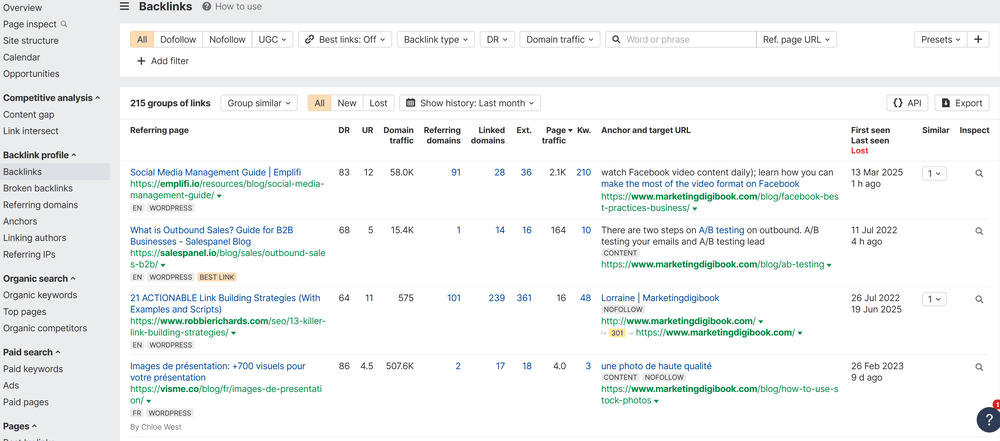
Use Ahrefs or Semrush to review which domains link to you. You’re looking for relevance, credibility, and natural patterns.
A local business with links from local organizations, partners, or respected publications has a strong “reputation profile.” A site with most links coming from unrelated, low-quality domains does not.
Step 2: Toxic link detection
If you find links from spammy domains — gambling, adult, or irrelevant foreign sites — you may need to add them to a disavow file in Search Console.
Disavowing is not something you do casually. But when toxicity is obvious and patterns are unnatural, you document and address it.
Step 3: Negative SEO check
Sometimes competitors or automated systems can harm a site by pointing large volumes of spammy links at it.
Watch for sudden spikes in referring domains. If your backlink graph suddenly jumps and the new domains are clearly spam, treat it as a warning sign.
Step 4: Build quality mentions
The best defense is building a strong baseline of high-quality mentions through PR, partnerships, guest content, or being cited as an expert in your niche.
Your Traffic Drop Probably Isn’t Random
Most ranking losses come from overlooked SEO issues. Download my Complete SEO Audit Checklist to quickly identify what’s broken, what’s underperforming, and what to fix first to regain visibility.
You have Successfully Subscribed!
7) Strategy & Growth Opportunities Audit — Turning the Diagnosis into a Treatment Plan
This is the part most people skip and it’s the part that turns an audit into growth.
An audit should not end with “here are 87 issues.” It should end with “here is the plan.”
Step 1: Low-hanging fruit
Open Search Console and look for keywords where you rank between positions 5 and 30. These are often the fastest wins.
Why? Because Google already sees relevance. You don’t need to “convince” Google from zero, you need to strengthen signals enough to move into the top results.
Typical improvements that push these pages upward include better titles, improved internal linking, refreshed content, clearer structure, stronger topical coverage, and better media (screenshots, diagrams, examples).
Step 2: Cluster expansion
Once you know your key pages, build supporting articles that strengthen those pages.
The script example is straightforward: if you offer “Trademark Registration,” supporting topics could include “Trademark Search,” “Trademark Costs,” and “Common Mistakes.” This expands topical authority and captures more long-tail intent.
Step 3: Content refresh
Revisit older posts and improve them. Add new data, better images, examples from your business, and clearer explanations.
Google loves updated content, but not because it’s “new.” It loves content that stays accurate, complete, and aligned with modern intent.
Step 4: Competitor benchmarking
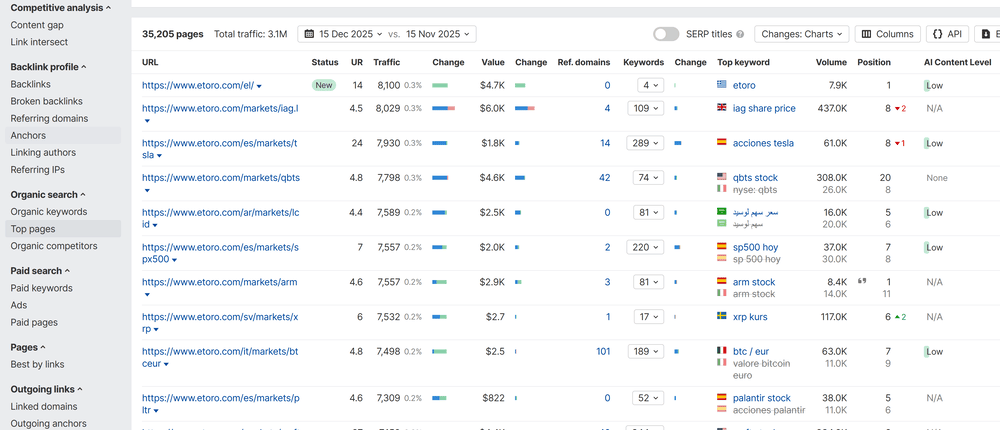
Use Ahrefs or Semrush to see which pages bring your competitors the most traffic.
Then study structure: how they format, what subtopics they cover, how they answer questions, what they include (FAQs, screenshots, definitions, case examples).
You do not copy. You learn the framework and then build a better version using your own expertise and real differentiators.
Step 5: AI and entity visibility
Search your brand or product in tools like ChatGPT or Perplexity. If your site doesn’t appear in citations, treat it as a visibility gap.
This often signals that you need more authoritative content, more reputable mentions, and clearer entity relationships across your site.
This is your long-term treatment plan, not just fixing issues, but building the strength and authority to dominate your niche.
Putting It All Together: What a Complete SEO Audit Really Does
At this point, you’ve seen what a complete SEO audit checklist looks like, from:
That’s why the best audits are not “reports.” They are decision-making tools. They tell you what matters, what’s urgent, what can wait, and what will drive the fastest compounding gains.
From Diagnosis to Expert Treatment: Making the Audit Actionable
By now, you’ve seen how many layers exist in a real SEO audit and how hidden issues can quietly block growth.
You’ve probably also realized that this isn’t just about adding keywords. It’s about understanding your entire website ecosystem.
And if you’re thinking: “This is exactly what I need, but I don’t have time to learn all of this or do it myself,” that’s where expert guidance can save months of trial and error.
A complete SEO audit should give you a personalized roadmap designed around business goals:
If you’re recovering from a traffic drop or a failed migration, you prioritize diagnosing indexation, technical regressions, and content decay first. If you’re trying to grow leads, you prioritize revenue pages, internal linking, topical clusters, and conversion alignment. If you’re expanding internationally, you prioritize hreflang, localization, and regional intent mapping.
It’s not just a technical report. It’s a clear, step-by-step plan that shows where your site stands today, what’s missing, and what to prioritize to see measurable growth.
Think of it as your website’s health check, one that turns confusion into clarity and clicks into clients.
Videos are virtually ubiquitous; statistics show that a third of online activity is now spent watching videos. More than 500 million hours of videos are watched on YouTube each day. Such statistics are why there is a rise in streaming services such as Netflix, IGTV, Amazon Prime Video, and many more; it also explains why over 87% of online marketers prefer engaging high-quality video content strategies for their campaigns.
Leveraging social video marketing is necessary to capture and satisfy a captive content-hungry audience. Over 51% of marketing professionals have cited video as the type of content with the best ROI. 81% of businesses use video content in their strategies. Videos are versatile, impactful, and very profitable digital marketing tools that you should not ignore.
Let’s Make Your SEO & Content Work Better for Your Business
When applied in the best ways, they will inspire your audience to become long-term visitors. So, with this said, here is a breakdown of how to achieve this in the easiest way possible, but first, here are the basic things you need to understand.
What Is Video Content Marketing?
Video Content Marketing is the practice of using videos to promote your products, services, and brand as a whole. It may embrace various forms like live videos, tutorial videos, explainer videos, DIY, or even customer success stories. You can simply say, video content marketing informs, educates, and entertains.
These videos can be used on landing pages, email marketing, social media posts, or even press releases and broadcasts.
What Is the Difference Between Video Content Marketing and Video Advertising?
With the above understanding of video content marketing, video advertising on the other hand could be considered as the running of video ads across digital platforms using advanced audience targeting to reach precise markets. It’s the paid component of video content marketing. You spend money to get a marketing video in front of a larger audience.
Why Is Video Marketing So Effective? How to Do Video Marketing and Why Should You Use It?
Today, to engage and inspire your audience, you have to tell a good story. And if it’s authentic, consumers will be more interested in what you have to say.
The challenge with most marketers is to actually tell a story that will rise above the noise. As a brand, you must cultivate your consumers’ attention and trust rather than consider them exclusively as consumers with choices that you must conquer. How do you achieve this? By telling stories that they want to hear.
A worthy story can communicate the entire personality of a brand in less than 2 minutes. When the correct features and formats are used, you can use compelling stories to break down any complex concepts about your brand and open up your world to them. Make them part of your brand story, after all, this is the whole purpose of marketing.
Video Content Marketing Benefits
As consumers crave human interaction and authenticity, the use of smartphones coupled with platforms such as YouTube and social media have made it easy for them to easily access videos, for brands, this means people can learn about your products or service in seconds. So, here are the advantages of video marketing:
a. It’s What People Want
Video marketing statistics show that video is the preferred source of information, consumers prefer videos to emails, social media images, or downloadable content e.g. PDFs. Most consumers search for products or product reviews in video format before purchase. Why is it so?
Video is super easy to consume, in such a busy world people don’t have time to read long product descriptions or dive into a long list of services, even the laziest consumers can just engage the eyes and ears and capture your product or service in action.
This is a great opportunity for brands to show themselves to consumers in a persuasive manner.
b. They Boost Conversions and Sales
Vision is the most dominant sense; it’s almost automatic that you’ll gain more when you incorporate video in your campaign. And because they increase the length of time people stay on your page, they end up giving your brand message a longer sink-in time.
Statistics have shown that 91% of businesses use video as a marketing tool.
This means you can engage, inform and attract new visitors and end up with good conversions.
c. Video Marketing Builds Trust
Besides high conversion rates and ROI, building trust with your consumers should be a solid goal on its own. This is how you create long-term relationships that lead to loyal customers. If you focus more on offering them relevant and useful information, they’ll invite themselves into buying.
Create videos that present your brand in a conversational form, this will build their confidence in you, and eventually, this will convert into a purchase.
d. Google Loves Videos Too – SEO Goldmine
Video Content Marketing can greatly boost your search engine ranking when properly applied. When you correctly reach your target audience, they end up spending a little more time on your site, this longer exposure develops trust and at the same time signals search engines that your content is worth the time (good quality).
This is especially so because Google owns YouTube, which means there are higher chances for your content to get noticed if you embed videos on your website.
The key thing here is to ensure that your content is optimized for SEO. This includes titles as well as descriptions.
One thing that is so hugely sought after by marketers is organic traffic. Brands are always working to get linked to high-quality sites because this does a great job of increasing a site’s authority which in turn increases the SERPs position, and this eventually boosts the amount of organic traffic they get.
But another much easier path is through consumer engagement. When you engage your audience well, you reduce even the bounce rate, and so far, as seen above, video has the highest levels of engagement.
Up to 62% of businesses who used video found that it helped boost the amount of organic traffic according to Wyzowl.
Link-backs and shares are made even more powerful with videos and this is why any video marketing company should create videos that are excellent for social sharing and for backlinking. The videos must provide a solution to an existing common problem, must be educative, and at the same time entertaining.
Your Traffic Drop Probably Isn’t Random
Most ranking losses come from overlooked SEO issues. Download my Complete SEO Audit Checklist to quickly identify what’s broken, what’s underperforming, and what to fix first to regain visibility.
You have Successfully Subscribed!
Types of Video Content Marketing
Even though the type of video marketing you use is mainly going to be determined by your objectives and the kind of business you’re into, it’s important to know the various types available.
Generally, there are three main categories of video marketing, these are:
Engagement Category – These videos are for drawing the viewers’ emotions in order to spark a reaction, whether it’s a like, a comment, or a share.
Awareness Category – These videos are for getting you known. They typically have a wide appeal to be able to capture as many viewers’ attention as possible.
Education Category – This category is about teaching your audience something that will add value to them.
With this knowledge of the 3 main categories, here are the specific types based on these categories.
Awareness Videos
i. Behind the Scenes Videos
One thing that really makes the audience feel like part of a process is the behind the scene videos if you have exclusive access to a process say production, project, or an occasion your customers would be interested in, consider creating a behind-the-scenes video. These kinds of videos involve lots of raw footage so they may not necessarily be very perfect. It however creates a sense of authenticity.
These videos put a personality behind the brand and make customers feel closer to them; they make the brand more human and less about just making profits.
Here is an example of a behind the scene video:
Source: YouTube
ii. Round Up Videos
These are majorly lists created regarding a certain theme, for example, “5 Best Holiday Destinations”. For these videos to be successful, the trick is to keep them short (around 4 minutes) in order to keep your audience engaged. They also need to include visuals of said products or places, not just your face speaking to the camera.
Give as much variety as possible having in regard customers have very varied tastes and choices.
Here is an example:
iii. Culture Videos
A brand’s culture is the secret sauce that absolutely taps into the consumers’ engagement appetite. This can include corporate sports day, birthday surprises, employee work-in-a-day experience, and so forth.
The main goal for this is to show that your brand is made up of humans with lots of personalities, not just a workstation with automated robot-like employees. And as companies out there struggle to be seen, you can stand out from the pack by differentiating yourself through a great personality. Your office or brand culture is a sure way of showing this.
iv. Interview Videos
Interviews are an excellent way of pumping some authority into your content. They build relationships with referral partners while exhibiting you as a crème in the game. A good interview should feel unscripted. Let the interviewee do most of the talking.
By inviting guests to an interview series, you’re able to easily come up with unique content while leveraging any new information that you may get from them. And as said above, this will build more credibility with your audience as well as your interviewee’s audience because the likelihood that they will share it with their customers is high.
Engagement Category
v. Vlogs
This is a diary type of video and it’s typically filmed by one person describing his or her experience or opinion about a certain topic. These seem to be replacing traditional blogs because they’re fun, more engaging and they’re also cheap to produce.
Most companies, however, have not mastered how to use vlogs and instead spend their campaign money on product demos and such content. However, vlogs are not just the territory of influencers alone, companies can use them to share their journey in a way that would be comfortable for them. It creates intimacy with the viewers.
vi. Live Events
Someone else might still break this into live videos or event videos, but here is why they’re perfect when working on one. If your company holds or participates in events, streaming it live will attract a higher engagement rate as compared to a video on demand.
Viewers spend up to 8 times longer when watching live events. For companies this is a great opportunity to engage with them in real-time, it also presents them with an opportunity to showcase more of what the brand has to offer while they still have eyeball time.
Education Category
vii. Explainer/ How-to Videos
These are videos made to walk your viewers through a certain process or solve a common problem. They’re typically short but precise. They offer a great opportunity to build your brand’s credibility and gain the trust of your audience.
viii. Product Review Videos
These types of videos are most popular with tech sites and the beauty industry. And they are so popular because consumers today buy products based on what they hear from friends or family, social media, and such reviews.
The audience loves them because they feel they can trust reviews made by people who have already used the products. As a company, reviewing your own products will definitely seem biased, what you do in such a case is identify relevant influencers in your niche and try offering them free samples and ask them to share their honest opinions in a video.
If you get recommendations, then you’re on the right path.
Testimonials are close to product reviews, except that these are mainly like company reviews. They are perfect when done during a company event, where you can record live testimonials from existing customers.
Alternatively, you could create a contest or offer a discount for customers who can offer in-person video testimonials. Generally, you want your customers to raise any concerns they might have encountered while buying the product, the results versus the expectations they had, any specific feature they liked the most, and what they would want potential customers to know about the product or company in general.
x. Live Talks/ Presentations
You can always take advantage of an opportunity where a team member is giving a speech or presentation by filming it and using it for marketing. Double benefits. Another way brands can benefit is by giving targeted talks at related company events or small-scale networking events.
8 Effective Steps for Developing an Effective Video Content Strategy
Any video content strategy that has as its main and only purpose to sell is destined to struggle if not fail. Of course, selling is the final purpose of any marketing campaign, video marketing strategies have also this ultimate goal, but today’s audience wants much more than that. In order to be successful, your video marketing must entertain, educate and inspire, genuinely convince the audience that your offer is valuable and perfectly able to solve their problem.
Video Content Strategy Step 1: Know Your Goals
Your goal could be brand awareness, sales, or traffic generation, whatever it is, you ought to be clear and base each decision you make on this goal. Without goals, it will be impossible to measure the success of your video content strategy and one of the subsequent campaigns.
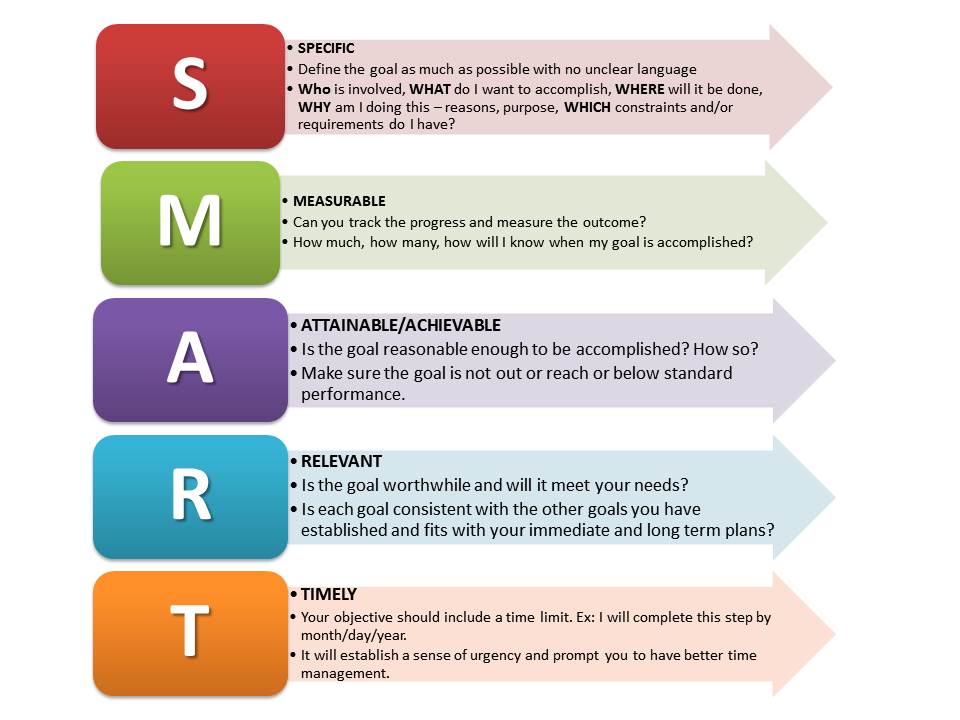
Successful goals must be specific. This simply means knowing exactly what you want to achieve. They should also be measurable, meaning you must identify key performance indicators that can be used to measure success. These goals must also be attainable or achievable and relevant to your overall business. Finally, they must be time-bound; you must have a specific time frame in which these objectives can be achieved. This will guide every step that you take and the time to spend on it.
Step 2: Understand Your Audience – Research and Insights Are Keys
A good campaign always starts with thorough research on who you’re targeting and what you want from them. Here you must know the kind of content that will resonate with them and as consumers’ appetite for video content increases, brands are learning that targeted video content that’s specific to their audience’s needs and solutions is what’s driving better outcomes for their campaigns. What this means is that the content you create should be about your target customer and must be what they’re looking for.
By being relevant to them, your content will attract more of the right kind of customers because they will organically align themselves with your brand. Use analytics and metrics to review previous data and see the things that your customers liked in the past and use similar content to find more potential customers.
Video Content Strategy Step 3:Type of Video and Where to Publish It
Having identified your specific target, it will now be easier to depict the best place to find them and the type of video that will work best. Consider the story you want to tell them and identify the video style that will suit them best.
Another important factor to consider is where this entire video campaign will fit within your brand’s customer journey and marketing funnel. Have in mind that all your customers are not in the same spot in their purchase journey, so your message and videos must address all of these various points.
There are various platforms you can use to publish your video; the main ones are Facebook, YouTube, Instagram, and Twitter. This, however, is largely dictated by your target audience, publish it where they are.
Step 4: Set Your Budget
Your budget will always influence the creative tactics you can employ. And all the video marketing examples listed above vary in cost because they all vary in the kind of resources they will require. This notwithstanding, the quality of your video and its authenticity should be a priority.
Another consideration will be whether you will create this video in-house or you’ll outsource it to a production team.
You must also consider the frequency of creating them and the equipment needed such as the video camera, a tripod, a stabilizer, lighting, audio, and editing equipment among others. If at this point you can’t afford any of this, start with your smartphone. It’s not that complicated.
Video Content Strategy Step 5:Identify How You’ll Measure Your Success
The good thing about video is that it’s quite easy to track the metrics. Some of these metrics include:
Average view duration – Measures how long viewers watch your videos on average.
Average completion rate – Measures your video’s ability to keep the viewer’s attention.
Re-plays – Number of times people re-watch your video.
Audience retention – This shows you the number of people that watch the video from beginning to end.
Click-through-rate – Measures how viewers respond to your call to action.
Engagement – Shown by likes shares and comments.
And also, take a look at experts and check on their video marketing mistakes, in order to avoid them.
Step 6: Create!
This is the fun part. Here you may encounter a few issues e.g. your editing skills may not be professional yet, you may discover that you need more than one camera angle and so forth, there is the lighting issue and the truth is, your first video is not going to be your best video, but it will place you in a position to get better, so go ahead!
Video Content Strategy Step 7: Edit and Publish with SEO Guidelines in Mind
There are myriad free video editing programs and apps available. Examples include Adobe Premiere, Corel Video Studio, CyberLink Power Editor, Movavi,or Splice. Keep the best clips and cut out unnecessary footage.
Once you’re done editing, publish your video while considering SEO guidelines. These include optimizing your title, description, and use of hashtags with relevant keywords. While applying this, don’t forget to be catchy and appealing.
With this done, you’re good to publish!
Step 8: Promote
Finally, remember to promote your video across all relevant channels, depending on where your target audiences are. This could mean through emails, social media channels, affiliate websites, and so on.
Responding to any comments you receive on your video is also a great way of boosting engagement which may lead to more shares.
Your Traffic Drop Probably Isn’t Random
Most ranking losses come from overlooked SEO issues. Download my Complete SEO Audit Checklist to quickly identify what’s broken, what’s underperforming, and what to fix first to regain visibility.
You have Successfully Subscribed!
5 Super Tips for Incredible Video Content Marketing Strategy Success
1. Optimize Your Content
It can’t be emphasized enough, so here it is again, SEO is a big deal. First of all, Google loves video content, so to maximize your video marketing campaign, ensure you accompany the video with a well-written description and title that are tagged with relevant keywords to boost your SEO.
2. Call to Action
Remember a marketing video has a goal; there is a certain action you want the person consuming this content on the other side to do. Include a call to action by encouraging them to take this action albeit in a subtle manner.
3. Tell an Interesting Story
As said earlier, focusing your video purely on sales alone will get you ignored! Tell your story in a way that your viewers can connect with. Humans are emotive beings, take advantage of that and speak to their emotions as you appeal to their needs and desires.
4. The First 10 Seconds Will Make or Break Your Video
The first ten seconds act as your subject line, if it doesn’t inspire, inform or entertain your viewer, you will be in trouble. The online attention span of viewers is just 8.5 seconds. You must therefore be able to bring life to your story within these 8 seconds. In this short period, you must be clear on what you’re all about and why you’re worth your viewer’s time. A quick preview of what’s featured in the video is one way to capture them.
5. Share, Share, Share!
This is really simple, having known where your target audiences spend their time, act, and share your video in these places and any others you may think of. You never know where a new loyal fan is going to pop from.
Conclusion
The play button is the most compelling call to action on the web right now and while this is happening, using writing to communicate with your audience is quickly going out of style. The importance of video marketing can therefore not be over-expressed. A brand is no longer what it tells the consumer it is; it’s what the consumers tell each other it is, and video marketing strategies go a long way into influencing these consumer-to-consumer talks by bringing authenticity and relevance into marketing. So, go ahead and create videos.
SEO content strategy is the core part of a powerful content strategy and practically decides what topics to write about, how to write them, and how to optimize them in order to rank in search engine results pages and attract organic traffic.
It includes all the tactics applied from identifying the content pillar topics and target keywords to creating content briefs and procedures of on-page optimization.
The main purpose of the SEO content strategy is to create content that will help the business reach its goals. And to offer guidelines for doing this in an efficient manner.
Having a documented SEO content marketing strategy in place has several consistent benefits:
Keeps content creation organized and inflow
Prioritizes tasks and allocates resources better
Supports attracting more qualified leads into your sales funnel and ultimately improves the chances of converting more leads to paying customers
Let’s Make Your SEO & Content Work Better for Your Business
How to Create an Effective Google SEO Content Strategy?
Since Google gathers more than 90% of the search requests, it is pertinent to say that businesses looking to rank organically have to optimize for Google search.
Creating an effective SEO content strategy may be a daunting task but it will ease the operations and execution of content down the line. Thus, it is preferable to craft it from the very beginning, then have to correct and clean up after that.
SEO content strategy is an extension of the content strategy and will be built on its canvas.
Here are the detailed steps of the SEO content strategy:
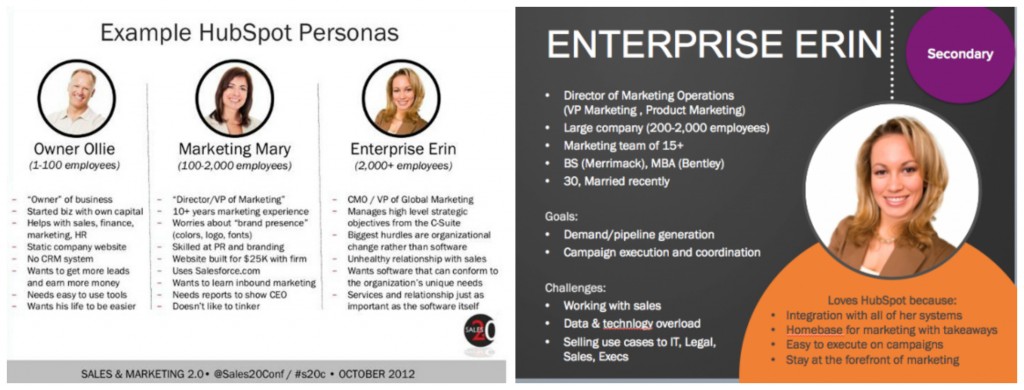
Consider Each Buyer Persona and Their Buyer Journey
Even if we are discussing the content strategy from an SEO point of view, one cannot discard the fact that first and foremost you create content for your buyer persona. You need to answer its pain points, questions, and interests concerning your offer.
Your buyer personas and their associated buyer journeys were already created and established by your content strategy. As such, now you just have to transfer them to the SEO content strategy and keep them in mind when completing the subsequent steps.
Primarily you should have a clear understanding of what’s your business offer, what its goals are, why would a potential client choose your company instead of the competition, and who’s your target audience.
Unless you are a brand new company or haven’t yet dug into content marketing, you have already published content. And you need to audit it from an SEO perspective and have a clear picture of its quality and performance in the general framework of your content strategy.
A content audit was most probably executed within your content strategy. So, now you have to take the list with the articles and pages of the site and review them taking into consideration the on-page SEO best practices.
You should verify at least the following:
Topic and its importance for the topical authority
Main keyword, LSIs, and PAA questions
Search intent for the main keyword
Content format and length
Content structure
Permalink
Keyword insertion
Images, graphics, and visuals
List all the improvements and updates that are needed and establish their priority in the function of the performance of the page and its importance for the topical authority.
The Output of the Competitor Analysis
Keeping a close eye on the competition can offer your business an edge. It’s a task that should be executed at least quarterly. Hence, the reality is quite different. Research sustains that 40% of B2C content marketers only check out their competitors yearly, if ever.
An SEO content strategy is incomplete without researching in detail what is your direct competition doing. Identify your direct competitors and check their content strategy, see what keywords they rank for, what are their most performant posts, etc.
Getting inspired by your competitors will offer some valuable insights into what is working in your niche in terms of content.
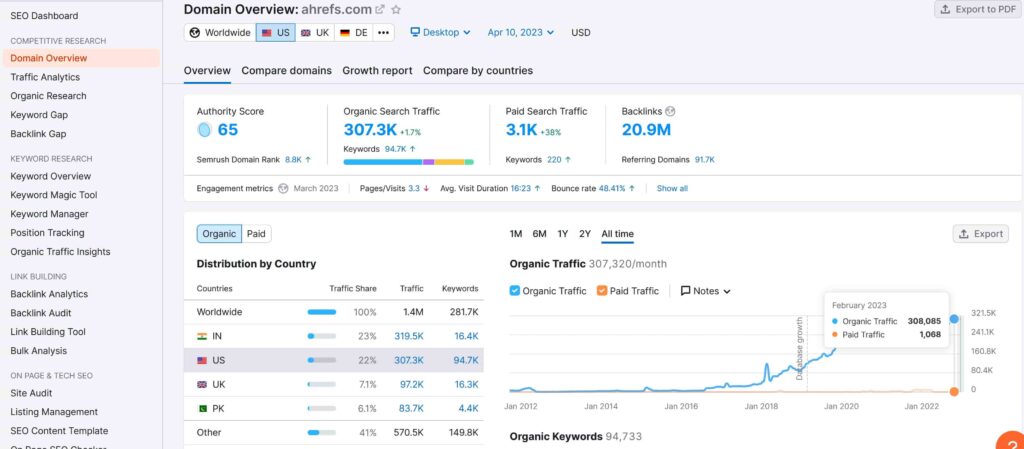
To research your competition you need an SEO and keyword research tool like Ahrefs, Moz, Semrush, or similar. Check for each competitor KPIs like:
Domain authority (DR)
Number of organic keywords
Number of organic keywords in the top 3
Monthly organic traffic
Linking domains
Organic traffic value
Source: Semrush
Competitors analysis can provide you with valuable content ideas, topics that you are missing, backlinks that you are missing, among others.
Metrics Setup
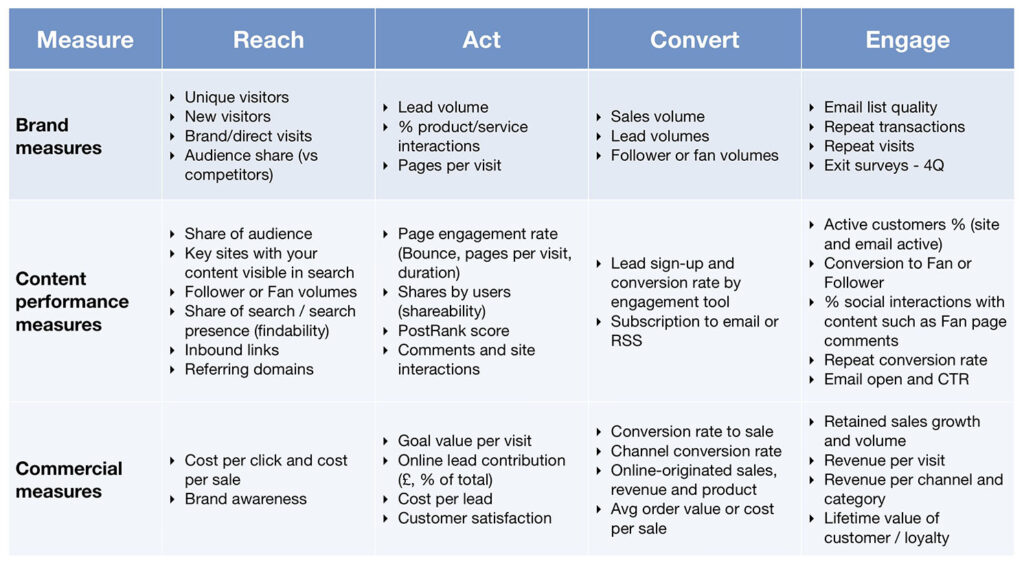
SEO and Marketing managers will be interested in calculating the ROI of SEO activities. And which specific activities bring the most revenue. To be able to determine that, you need to establish and monitor the key performance indicators that are relevant to your business in the next period.
The most used KPIs are:
Organic traffic
Dwelling time
Number of organic keywords
Content pieces published
Backlinks acquired
Number of featured snippets
Subscribers
Leads
Conversions
You should be tracking your metrics at least quarterly if not monthly.
Topical Authority Should Be the Foundation of Your SEO Content Strategy
In SEO, topical authority refers to how many topics and to what extent a site covers relative to a certain topic.
For example, if you have dozens of articles published on the subject of “content strategy” and its subtopics, Google will consider you an authority on that topic. And the more semantically related keywords you cover, the more authority your site gains.
To identify all the subtopics that will help you build authority on a given topic, you have to use Google and/or a keyword research tool. And filter all the related keywords and all the semantically related ones pertinent to your topic and business.
Creating SEO content strategy based on topical authority is a laborious process, but it’s a useful methodology if you want to pop up in SERPs.
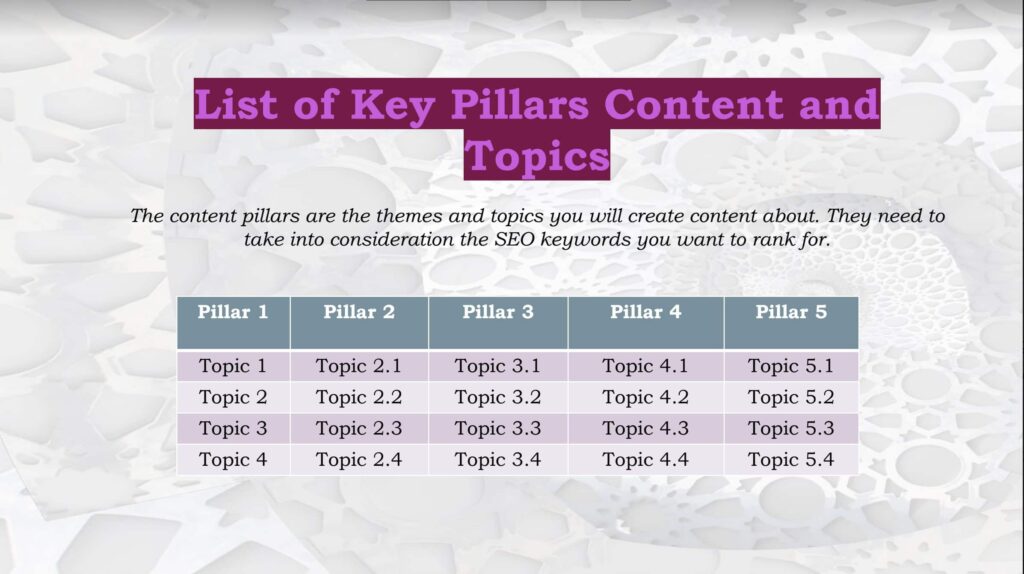
Based on Your Product/Services Identify the Key Content Pillars
Knowing what are your services/products, who’s your buyer persona, and what are your content marketing goals you can start searching for keywords and content topics.
Conduct a keyword research and identify keywords that have:
Business potential
Ranking perspective
Organic traffic potential
Start by searching in Google for the term you are most interested in ranking. Use a broad term. After that check the search suggestions, PAA (People Also Ask), and related searches for the first 10-15 pages. Filter just the topics that are relevant to your business.
For example, if you offer content strategy services, you will search for “content strategy”. Additionally, you can do this in a keyword research tool like Ahrefs or SurferSEO. This will be the basis of your SEO content strategy.
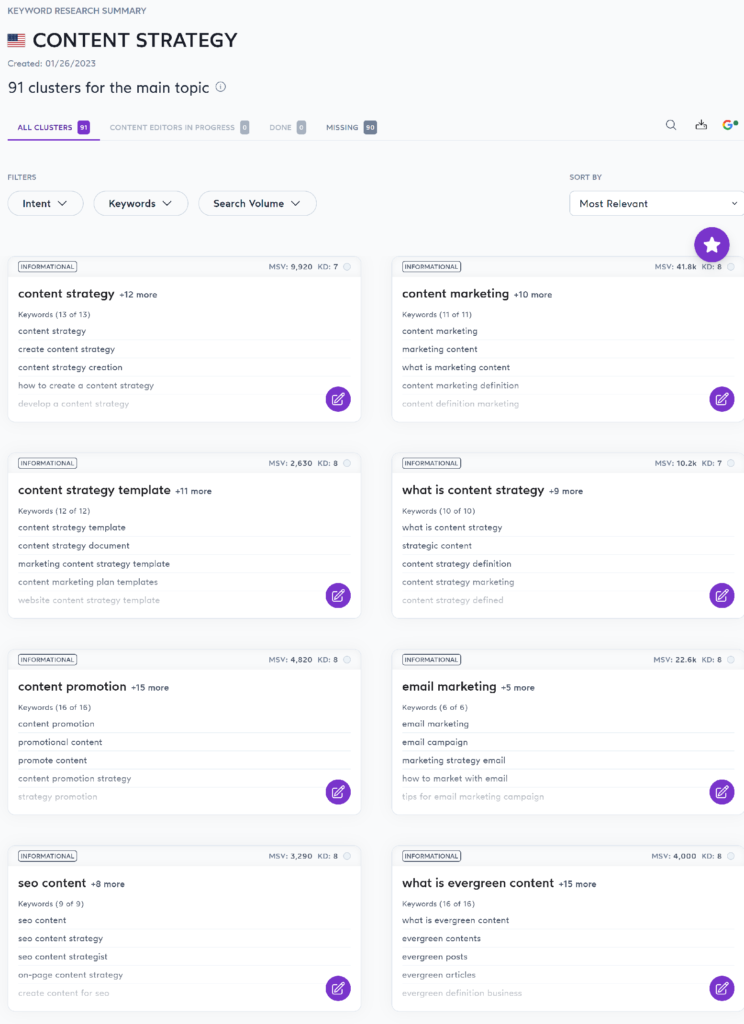
Once you have this list with keywords you have to group them into topics clusters. In a tool like SurferSEO, the topics will look like this:
You don’t necessarily need a tool to do this, you can do it manually, but it will save you time.
When you have these clusters defined, prioritize them in the order of their importance for your clients, for your business, and from an SEO KPIs point of view. You also have to consider the difficulty for each keyword, the search volume, and CPC.
Your top priority is the money-generating pages, those need to be first created, fully optimized, and hopefully rank.
Then choose the topics for which you want to be an authority in your niche. And second, those for which you can rank the easiest, meaning the so-called “low-hanging fruits”. Those who need the least resources and have the greatest chance of bringing traffic and leads.
Bear in mind that your expertise and your main purpose should be the core of your content creation strategy.
Next, for each cluster brainstorm a corresponding topic. Each topic should cover and solve a buyer persona’s problem, should have a unique angle if possible, or a different approach from your competition.
Having a strong SEO content marketing strategy based on topical authority in place has a compounding effect. The more content you produce to build authority, you will rank for more keywords and your domain authority will increase and will be able to rank for keywords with higher difficulty.
Pay Attention to Search Intent
When using keywords to produce optimized content, you should also take into consideration the search intent behind that search. Meaning what the user is looking for.
Google’s supreme purpose is to offer its users what they want, in the fastest possible manner. It knows what users expect to find when making a certain query.
For example, when people are looking for “how to make pizza” Google knows they are looking for a recipe. Or when looking at “how to create a GIF”, users expect to find a how-to guide.
By figuring out the search intent you are in a better position to create more relevant content.
Thus, Google will guide you regarding the search intent behind each keyword from your list. Search each keyword on Google and identify
The type of content you need to create – blog post, product page, video, etc.
Content format – how-to, list, recipe, reviews, etc.
Your Traffic Drop Probably Isn’t Random
Most ranking losses come from overlooked SEO issues. Download my Complete SEO Audit Checklist to quickly identify what’s broken, what’s underperforming, and what to fix first to regain visibility.
You have Successfully Subscribed!
Write Search-Focused and Qualitative Content
The SEO content strategy has the purpose to equip your business with the best chances of attracting relevant organic traffic that will buy your services/products.
As a consequence, you have to produce high-quality content – meaning content that your audience finds useful, solves her problems, and drives her to consider your services.
And also search-focused content – in other words, content that is created for the correct search intent and is optimized via current on-page SEO best practices.
To create optimized and high-quality content you need first to draft content briefs and implement correct on-page SEO procedures.
Draft Content Briefs for Your Writers
If you want to create content smoothly, without many revisions and supplementary rewriting activities, creating detailed briefs is a must.
An SEO content brief includes the necessary instructions for the writer to write a correctly optimized article, with the right structure and keywords. Clear instructions and guidelines to follow. Thus offering the article the best possible chances to rank in SERPs.
In a content brief, the following information should be included:
Title
Summary, search intent, and angle
Target keywords
Target buyer persona and stage of the buyer journey
Tone and voice
Structure of the article (H2 headings)
Resources
NLP words
Lengths of the article in words
Deadline
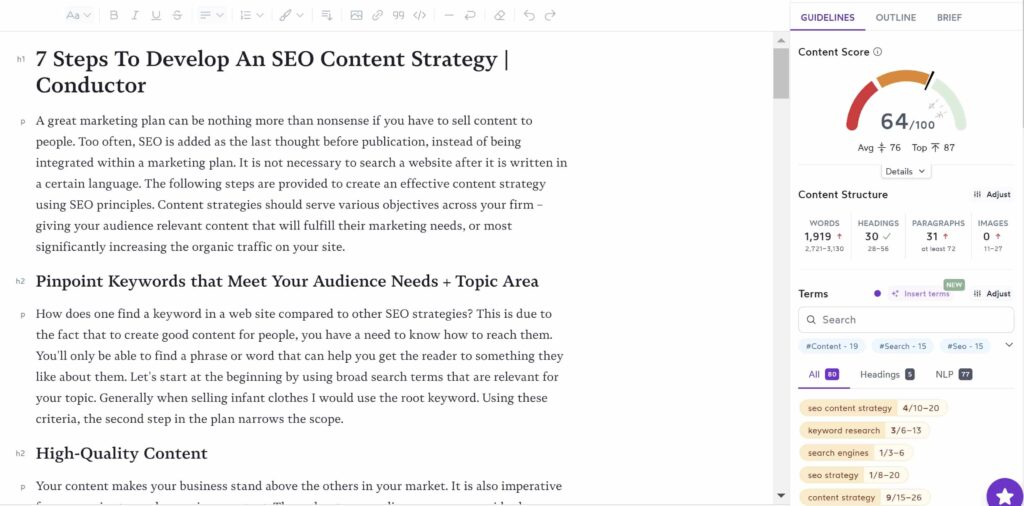
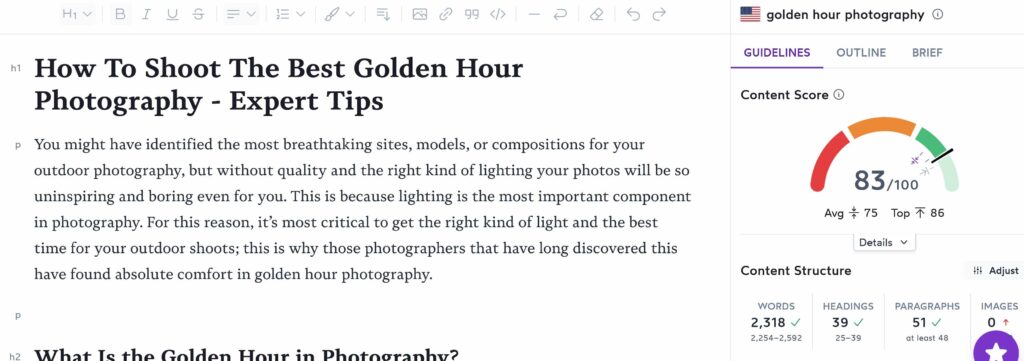
You can create the briefs manually (still the best way in my view) or use a brief generation tool. There are countless tools out there ready to generate your briefs, but all of them need manual reviewing and corrections.
You can view below a sample content brief generated via SurferSeo.
Define On-Page SEO Best Practices to Be Implemented in Each Piece of Content
On-Page SEO is the foundation of SEO, it’s compulsory if one wants his articles to rank and it’s an SEO task under your control.
On-Page SEO is a must-have, as most businesses already implement it. Implementing current on-page best practices right from the writing phase will spare future efforts of rewriting and optimization.
When Creating Content Consider the E-E-A-T Principles
Google clearly stated that a core part of its metrics revolves around E-E-A-T (Experience – Expertise – Authoritativeness -Trustworthiness). In other words, they are emphasizing the quality of the content delivered to the user.
The content produced should prove that the business has first-hand experience and expertise on the topic to be granted higher chances of ranking.
Each site will be evaluated for a certain topic based on the E-E-A-T template. It is also done for each query and for each result.
Consequently, you have to produce content for your target audience while positioning your business as an authority in your niche. And build trust.
Pay Close Attention to Your Internal Links Architecture
Internal linking structure is important for your users and search engines alike. First, your users should be able to find their way and navigate with ease your site to get the information they need. And second, search engines should be able to crawl your site and find all the published content.
Plus, search engines should be able to identify which are the most important pages for your business, the ones that you want to rank for, and the supporting pages for the latter. In addition, a pertinent anchor text will indicate to Google what keywords you are looking to rank for.
Your site’s internal linking structure is like a map with main roads and secondary streets. All connecting with each other in some way. This internal links architecture is important as the link juice is redirected from performant pages to those needing supplementary support.
Internal links play an important role in SERP ranking.
Perform SEO Content Audits Regularly
To continuously improve your site rankings you have to keep an eye on your most important keywords. Track them with a keyword research tool to help you identify ranking improvement opportunities.
It’s not enough to write and publish qualitative content. You have to perform audits, update it and review it periodically.
There are several reasons to do that. It might happen that your content doesn’t rank or it loses rankings. Or search intent changes. Or content gets outdated.
Search engine algorithm updates are frequent and SERPs are dynamic, they change continuously.
When executing an SEO content audit you have to check on the following:
What is the situation of your traffic? Is It growing, stalling, or decreasing?
Which are the most performing pages? Which drive the most traffic? How about conversions?
Which pages do you need to rank and they actually don’t rank for the right keyword?
What can you do to improve the rankings?
Based on this information you can adjust your future plans. Prioritize performing pages, update those that are less performant following the model of those that bring the most results, etc.
Keep an Eye on Google Algorithm Updates
There is no news that Google updates its algorithm several times a year (core updates). Even if minor updates might not impact your rankings, core updates may at times have a significant impact.
Consequently, you have to keep updated about what future algorithm updates require to maintain the performance of your content and site.
Conclusion
A date-based and successful SEO content strategy is an absolute must if you want to attract organic traffic in a more complicated and crowded environment. Plus, the challenges brought by the newly developed AI technology. Following the above-mentioned steps and keeping yourself updated will help solve future challenges.
The top 5 SEO strategies may be considered the following: High-Quality Content Creation Topical Authority On-Page SEO Off-Page SEO Technical SEO
What is an SEO content plan?
An SEO content plan is a document that clearly defines what content will be created, what keywords will be targeted, guidelines for content creation, and on-page optimization. All these have the purpose of reaching the business goals.
Is SEO a content marketing strategy?
SEO is a core part of a content marketing strategy. SEO doesn’t exist on its own without a content strategy.
What is the key to SEO?
The key to successful SEO is clearly defining your business goals and defining and implementing an SEO content strategy to show you how to reach those goals.
How to integrate SEO into your content?
To integrate SEO into your content, you should put in place an SEO content strategy to define the keywords to rank for, the topics to write about, and the guidelines for on-page SEO optimization.
Is SEO part of content strategy?
Yes, SEO is a core part of the content strategy.
What is the core of content strategy?
The core part of a content strategy is creating content that is considered useful by the buyer persona and is optimized to rank in search engines. Its mission is the help reach the business’s goals.
What are the 3 C’s of SEO?
The 3 C’s of SEO may be considered content, credibility, and conversion.
Can meta description be the same as content?
The meta description is not the same as the content. It is a brief summary of a page and is an HTML element.
Are you feeling overwhelmed when it comes to creating content briefs? Do you struggle to find a balance between providing enough information and not getting bogged down in the details? If so, you’re not alone.
Writing a content brief can be a daunting task, especially when you’re working on a tight deadline or managing multiple projects.
Reading this post will provide you with tips from the pros on how to conceive a content brief without feeling overwhelmed. We’ll break down the components of a content brief and provide you with a step-by-step guide on how to create one.
It’s understandable that the thought of writing briefs may seem intimidating, but it doesn’t have to be. Here is help to streamline your process, save time, and ultimately produce high-quality content that resonates with your target audience.
So, let’s begin the journey toward creating a content brief that not only meets your needs but exceeds your expectations.
Let’s Make Your SEO & Content Work Better for Your Business
A content brief is a document that shows how to write and what to include in a piece of content. It outlines the objectives, and parameters needed, the purpose of the content, the target audience, the key messages, and the outline that needs to be conveyed.
A content brief is the backbone of any content creation process, helping to keep everyone on the same page and ensuring that the crafted content is aligned with the marketing goals and objectives.
An SEO content brief is similar to a content brief but with an added focus on search engine optimization (SEO). An SEO content brief not only indicates the objectives, and outline of the project but also includes specific instructions and guidelines for optimizing the content for search engines. It might include:
Keyword research
On-page optimization
Interlinking strategies
Meta tags
The main difference between a content brief and an SEO content brief is made of the optimization parameters.
Why Are Content Briefs Important?
Creating a content brief is crucial for an effective content creation process. Without a clear plan in place, it’s easy to get lost in the weeds and lose sight of the overall goals and objectives of the project.
A content brief offers the necessary guidance and helps to keep everyone on the same page.
In the context of marketing, a good example of the importance of a content brief can be seen in the creation of a blog post.
Let’s say that a company wants to create a blog post about a new product they are launching. Before they start creating the piece of content, they should develop a content brief that outlines the following:
The target audience for the content (potential customers).
Key messages that need to be conveyed (benefits and features of the product).
Main keyword and semantic terms that should be included in the content (e.g. the name of the product, related search terms, etc.)
The desired outcome of the content (increased awareness and interest in the product, potential sales)
With this content brief in place, the company can then start creating content that is targeted toward their desired audience and optimized for search engines.
By following the guidelines outlined in the content brief, they increase the likelihood that their content will be discovered by search engines and, ultimately, by potential customers.
Advantages of Using Content Briefs
One of the main advantages of using content briefs is that they can prevent the need for rewrites and repetitive revisions. By having a clear plan in place before starting the content creation process, teams can avoid costly mistakes and minimize the need for time-consuming revisions.
This saves time and money and allows teams to focus on more important tasks.
Research conducted by Ziflow found that more than half of the marketing teams review an asset three to five times before it is considered final.
Another advantage of using content briefs is ensuring no critical information and data are missing. When creating content, it’s easy to overlook important details that can make or break the success of the project.
Content briefs help ensure that all necessary information is included and that the content meets the buyer persona’s needs.
In addition, content briefs provide a guideline and a single source of truth for the collaborating team. They serve as a reference document that everyone on the team can refer to when needed.
Consequently, minimizing confusion and misunderstandings, and helping to ensure that everyone is working towards the same goal.
Lastly, content briefs provide clear direction. They serve as a blueprint for the project, outlining the goals, audience, tone, and format. And ensure that the content meets the needs of the intended audience and is consistent with the overall marketing strategy.
It also provides a clear way to measure success and obtain approval from stakeholders.
What Are the Components of a Content Brief?
In order to create a comprehensive content brief, there are several key elements that need to be considered. The key components of a content brief are
Topic and working title
Target buyer persona
Primary keyword
Search Intent for that keyword
Secondary keywords and LSis
Content format, and length
Stage of the buyer journey
Content goals and objectives
Content structure and outline
Content tone and style, and instructions for visuals
Resources
Internal links
Call to action (CTA)
Deadlines and milestones
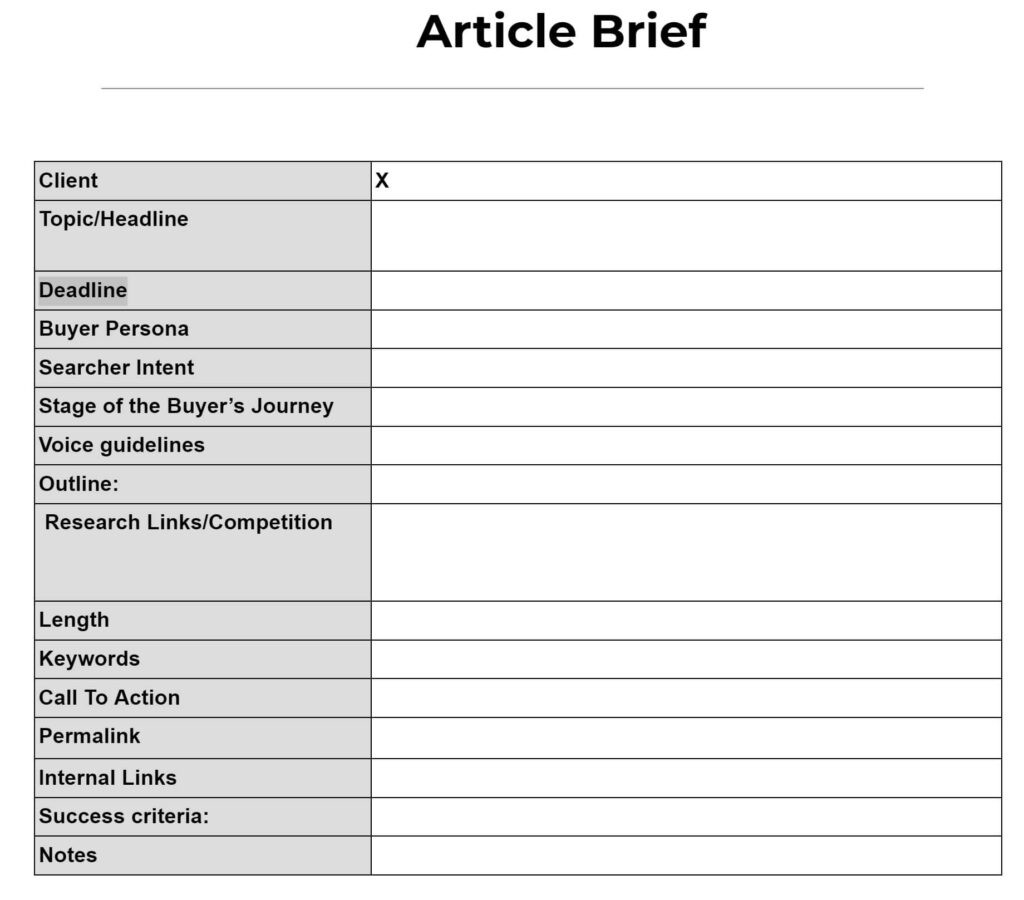
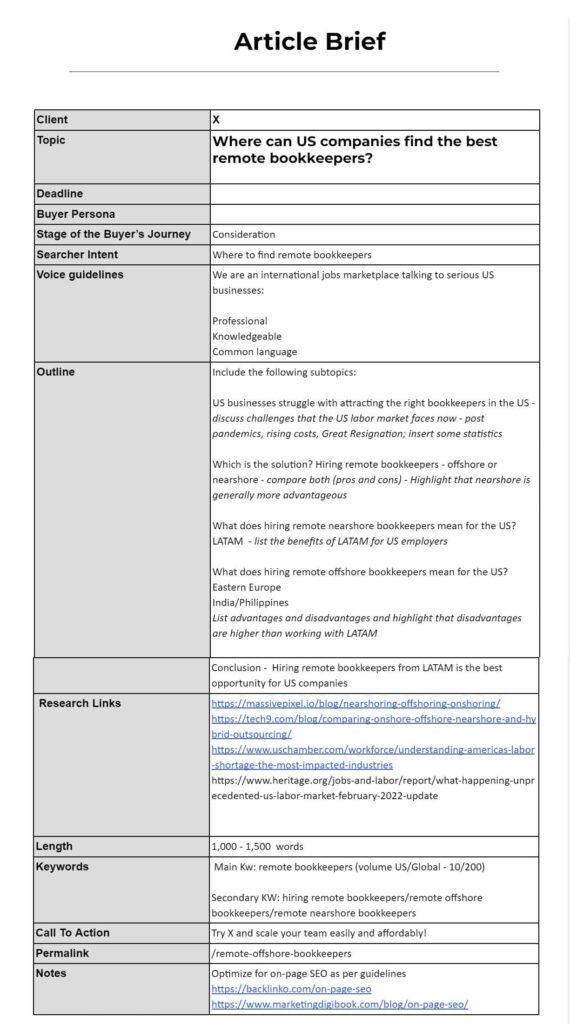
Content brief template
Content brief example
What Are the Steps for Creating a Content Brief?
To create a detailed content brief follow the next steps:
Identify the Target Audience – Overview of the Buyer Persona
The target audience is the group of people that you are creating the content for or your buyer persona. It is defined based on demographics, psychographics, or other factors.
Understanding your target audience is essential to creating effective content that resonates with them.
Example: If the target audience is working moms, the buyer persona may include information such as their age range, occupation, income level, and the challenges they face balancing work and family life. In your brief, you will include a reference as “Mom Mary” and a link to the buyer persona profile.
Execute a Keyword Research – Identify the Primary Keyword and LSIs
The primary keyword is the main keyword that you are targeting with your content. This keyword should be relevant to your target audience’s needs and should be included in the content in a natural and organic way.
LSIs (Latent Semantic Indexing) are related keywords and phrases that are also relevant to the topic of your content. Including LSIs can help to improve the relevance of your content and increase its visibility in search results.
Example: If the content is about time-saving tips for working moms, relevant keywords may include “working mom struggles,” “time management,” and “productivity hacks”. And LSIs for “working mom struggles” could be “working mom dilemma”, “ depressed overwhelmed working mom”, “challenges of working moms”.
Brainstorm Content Topic and SEO Title
The topic of your content should be based on your target audience’s needs and interests and related to your product/service.
Deciding on a relevant, optimized, and eye-catching title is not that easy. Bear in mind that the working title should be attention-grabbing and provide a clear idea of what the content is about.
It is important to keep in mind that the title is often the first thing that people will see, and based on it, they decide if they click on your article or not.
Example: If the target audience is working moms, topics may include time-saving tips, career development, or self-care. Working titles may include “10 Time-Saving Hacks for Busy Working Moms” or “How to Advance Your Career While Juggling Motherhood.”
Determine the Content Format and Length
The format and length of your content can have a significant impact on how it is received by your target audience.
Depending on the topic approached the format may be a listicle, a how-to, a guide, an ebook, etc.
Content length in words is also important. Usually, you want this content to be useful for your audience and rank in search engines. The word count should be in the range of already ranking articles and should cover the topic in depth.
Example: If the goal of the content is to drive conversions, a product comparison guide may be the most effective format of content. The angle of the content may be based on a trending topic or a pain point that the target audience is experiencing.
Establish the Stage of the Buyer Journey for the Piece of Content
The stage of the buyer journey that your target audience is in will influence the type of content that they are looking for.
For example, someone in the awareness stage may be looking for educational content, while someone in the decision stage may be looking for product comparisons. By understanding the stage of the buyer journey, you can create content that is tailored to their needs and more likely to convert.
Define Content Goals and Objectives
The goals and objectives of your content should align with your overall marketing goals.
For example, if your goal is to increase brand awareness, your content may focus on spreading the word about your product or services or sharing customer success stories.
By aligning your content goals and objectives with your overall marketing goals, you can create a more cohesive and effective content strategy.
Example: If the goal of the content is to generate leads, the objective may be to collect email addresses through a lead magnet.
Indicate the Content Tone and Style
The tone and style of your content should reflect your brand voice and values. This can vary depending on your target audience and the type of content that you are creating.
For example, a piece of content aimed at millennials may have a more casual tone and use humor, while a piece of content aimed at business executives may have a more formal tone and use data-driven insights.
Example: If the target audience is working moms, the tone may be empathetic and understanding
Determine the Search Intent Behind the Main Keyword
Search intent refers to the reason behind a search query. Understanding the search intent behind your target audience’s queries is crucial in creating content that matches their needs.
By understanding the search intent, you can create content that is more relevant to their needs and more likely to be found in search results.
Create the Content Structure and Outline
The structure and outline of your content should be based on the type of content and the goals that you have set. It may include headings, subheadings, bullet points, or other formatting elements.
The provided outline should be logical and easy to follow and should help to guide the reader through the content.
Example: Suppose the goal of the content is to inform the audience about the importance of a healthy lifestyle. In that case, the structure and outline of the content should include subtopics such as nutrition, exercise, stress management, and sleep.
List the Resources
Resources are an essential component of a content brief. It is crucial to specify the resources needed to create the content. Resources include anything that the content writer needs to successfully complete the project.
This can range from research materials, case studies, statistics, images, videos, or any other type of media. Or competitor articles. By specifying the resources, the content creator can plan and allocate sufficient time to organize them and extract the right information.
When creating product pages or other landing pages, or infographics, it’s useful to indicate a design mockup or at least similar examples.
Additionally, this helps to avoid unnecessary delays and reduces the risk of missing essential data.
Example: Suppose the content is about the benefits of a plant-based diet. The resources that need to be reviewed may include scientific studies, books, and online articles from authoritative sources on the topic.
Your Traffic Drop Probably Isn’t Random
Most ranking losses come from overlooked SEO issues. Download my Complete SEO Audit Checklist to quickly identify what’s broken, what’s underperforming, and what to fix first to regain visibility.
You have Successfully Subscribed!
strategy template
Determine the Call to Action (CTA) That Will Be included in the Content
A call to action (CTA) is another important component of a content brief. The CTA informs the reader of what action they should take after engaging with the content.
For example, a CTA could be encouraging the reader to subscribe to a newsletter, purchase a product or service, or schedule a consultation.
By including a CTA in the content brief, content creators ensure that their content has a clear and specific purpose that aligns with the brand’s overall marketing strategy. Moreover, a well-crafted CTA can help improve conversions.
Example: Suppose the call to action for the content is to sign up for a free trial of a meal planning service. The content should include a link to the trial sign-up page and clear instructions on how to sign up.
Establish the Deadlines
Deadlines are the final essential component of a content brief. A deadline refers to the date and time when the content must be completed and delivered. Including deadlines in a content brief is vital as it helps to keep the project on track and within the specified timeline.
By specifying a deadline, content creators have a clear understanding of when the project should be completed, allowing them to manage their time effectively. Additionally, deadlines ensure that all stakeholders involved in the project are aware of the delivery date, minimizing the risk of delays and missed opportunities.
It is essential to consider each component of a content brief to create effective content. Neglecting any of the essential components can result in content that fails to meet its objectives.
For example, if a CTA is not specified in the brief, the content may lack direction, and the audience may not know what action to take after consuming the content.
Similarly, if resources are not adequately indicated, the content may be incomplete or lacking vital information. Finally, failing to set a deadline for content delivery can lead to delays, missed opportunities, and unhappy clients.
Now, you have heard for sure that content briefs can be generated by AI-driven tools. There are plenty out there. In my experience, none of them delivers great results, but help speed up the process and reduce the time needed for creating a solid content brief.
Key Differences Between a Manual Content Brief and an AI-Generated Content Brief
Manual briefs rely on human input and creativity to develop customized briefs, while AI-generated briefs use algorithms and data analysis to develop a brief based on predetermined criteria.
The manual approach offers greater flexibility and adaptability to changing project needs, while AI-generated briefs may be more rigid and difficult to modify.
Manual briefs allow for more nuanced messaging and tone, while AI-generated briefs rely more heavily on keyword optimization and data analysis.
Even though they are not as highly qualitative as manual briefs, AI-generated briefs can be developed more efficiently and are useful when producing content at scale. Executing them manually requires more time and resources to develop due to the need for human input.
Manual briefs are better suited for complex projects that require human expertise and creativity, while AI-generated briefs may be more suitable for standardized or routine content creation tasks.
Finally
Creating a content brief doesn’t have to be overwhelming. By breaking it down into manageable steps, and focusing on your target audience and marketing goals, you can create a clear and concise brief that will help you achieve your marketing objectives. So go ahead, give it a try, and don’t forget to celebrate your successes along the way!
The digital content marketing strategy is essentially a blueprint that includes processes, standards, and topics to help you plan, create and publish your content.
The content marketing strategy is the foundation of reaching your business
. It is a sort of magnetic compass that you have to craft on your own measure to show you the way to your objectives. And of course, we are all striving to find the best content strategy that works for our business.
“The essence of strategy is choosing what not to do.” Michael Porter
It’s a guiding line that organizes the marketing teams involved in producing content: writers, editors, SEO specialists, designers, producers, project managers, analysts, etc., identifies the needed tools and channels and provides procedures and workflows. And aligns all the stakeholders involved toward the same goal.
Remember your digital content marketing strategy line needs to be flexible and your team agile. In our ever-changing world, it happens quite often that the situation forecast in January has nothing to do with the reality of May.
Useless to reinforce why you need a content marketing strategy, it’s vital to have a path that leads you toward your goals.
When you need to arrive from point A to point B, you establish in advance a route. This is similar to your business, to achieve the goals you need a route, and that’s the strategy.
A simplified content strategy template that will definitely help you in your endeavors of creating your strategy is to be found if you click the aforementioned link.
A successful content marketing strategy is the ultimate game-changer for your business. Because it’s one of the key things that will give you an edge over your competitors. Investing in it is therefore well worth all the effort.
Audiences have become smarter and more discerning today than ever, they’re looking for value and relevance. Most of them, as time goes by, are becoming media-savvy and can now tell the difference between the noise in traditional advertising and real content that serves their needs. And this is where content marketing is king, it’s what will help you create and deliver the information your audience needs.
What Do You Hope to Gain from Solid Content Marketing Strategy?
a. It’ll Help Establish Trust with Your Audience
People tend to lean towards something that offers them relevance and value. This forms a good basis for trust. By connecting with your customers and giving the answers to their questions through the content you deliver them, you will be building a solid relationship that they can always come back to.
Consistently offer quality content to your audience and find yourself building a good reputation for your brand, which will consequentially attract the trust and loyalty that you need.
b. It’ll Bring Them Back for More
When you offer your audience just the right content, they will get a positive experience. Whenever they visit your site or social pages they will get solutions and this will keep them coming back for more. The positive experience reinforces how they see and feel about your brand.
c. You Gain Authority
Churning out great quality content is your business’s way of flexing your muscles and proving your expertise in your field. When you publish content that solves your audience’s specific issues, your audience will look at you as an expert worth her attention. This will boost your authority and rank your content higher.
d. It Generates Leads
Generating leads is one of the key goals of any marketing campaign and quality content is at its heart. The calls to action become very instrumental in generating leads to your landing page.
e. Boosts Conversion
For most businesses, this is the ultimate goal. And this will be easier if you provide your audience with useful information that they can eventually trust over time. With trust established, and with the right calls to action, the purchasing decision will be in your favor.
Thus, this is a strong relationship between quality, relevance, and offering solutions.
Let’s Make Your SEO & Content Work Better for Your Business
What is a content marketing strategy without the key elements? These are the building block of effective content marketing efforts.
a. Positioning
This can be considered as the manner in which you get your brand out of obscurity by creating awareness about all the solutions you offer to your audience through the aptest platforms thereby amplifying your expertise to a higher position of great reputation.
When you set yourself as an expert in your niche, you’ll have the leeway to set higher rates for yourself and set yourself up for greater opportunities. This means being in each place where your audience looks for solutions to their problems. When you position yourself on multiple platforms sharing your expertise, you’ll build higher confidence with your audience.
b. Value Proposition
When your audience’s needs meet your solutions in perfect positioning, magic happens. However, achieving this requires navigating through clear communication, true perception, and delivering on your brand promise.
And this is where a good value proposition comes to play. It’s the baseline promise to your audience. A clear expression of what they stand to gain by purchasing your product or service. It’s about the thing that makes you unique and makes you stand out from your competitors to the advantage of your customers. Identify it and offer it.
c. Business Case
The next important element in online content marketing strategy is about driving your brand forward. This will require clearly defining your goals (read below) in order to see how creating an inbound content marketing strategy will get you closer to them.
Knowing your goals will lead you to pick the resources to invest in in order to achieve your desired results. It will also help you have a clearer picture of the costs, benefits as well as risks of implementing your content marketing efforts.
d. Your Strategic Plan
This final element is meant to help plan every step that will support you in reaching your overall goals and how you’re going to measure them. You have to insert in a strategy the platforms you want to use and also the methods you will use to promote the content.
It’s a top priority to also consider the most appealing content type for your target audience. Often times a mixture of videos, blog posts or infographics would be a great approach.
To facilitate your task check the digital content marketing strategy template below, which I created especially to help businesses streamline their strategy creation efforts.
Your Traffic Drop Probably Isn’t Random
Most ranking losses come from overlooked SEO issues. Download my Complete SEO Audit Checklist to quickly identify what’s broken, what’s underperforming, and what to fix first to regain visibility.
You have Successfully Subscribed!
Now, let’s start and identify the core pillars that are sustaining your website content strategy:
If you are not starting from scratch, before committing to the creation of your digital content strategy for the next year, an audit and revision of the content you produced last year are compulsory.
· Inventorize your content. First, you need a quantitative evaluation of the content you already have. Where is it published? How many pieces are published? In which format? Which of them show up on the first page of search engines? Collect in an inventory list with data like link, author, publishing date, last update, keywords, etc.
· Content audit. This is a qualitative evaluation of the content you listed in the content inventory list. Which is the quality level of this content? Does it meet your actual quality standards? Is it in line with your brand? Does it answer properly to your audience’s pain points? Which pieces of content generated the most traffic and why? Which is the bounce rate? But the dwelling time? How are the social shares? Is the actual content converting according to targets? Search for explanations and answers to these questions.
· Competitor analysis. By examining competitors’ well-performing pages, you can understand which valuable pieces may be missing on your website. Use the SE Ranking SEO competition tool to investigate your rivals’ organic performance, find out which keywords work best for product or landing pages, and which are perfect for audience educational purposes. Also, make sure to check if there are any SERP features for queries you are going to target (like the “people also ask” section, featured snippets, or site links) and optimize your content for them as well.
· Identify the content gap. Search for topics that are not covered by your content and they should be.
Pillar 2: Establish Your Core Content Marketing Goals
The fundament of your own content marketing strategy is the goals that you want to achieve through your marketing efforts. These business goals are general high-level statements that your marketing efforts will focus on and are established by the top management for the whole organization. Such goals could be:
* Create brand awareness. If your company/business is new, your primary goal will be to create brand awareness, to reach as much as possible of your target audience
* Boost traffic for your site by x%. This could be accomplished through search engine optimization, via organic traffic, but it will take time to rank and till the results will be visible in search engines. Or via paid traffic, which will bring results quicker but will require a higher budget.
* Increase conversions for your products or services by x%. You need to influence and convince a larger number of visitors to your site to become customers and buy your products/services.
* Build a reputation as an influencer/leader for your company. Your brand is much more than the effective products/services you sell. If you create high-quality content, and deliver great products/services that help your audience and exceed her expectations, in time you could build a solid reputation and confirm the status of a leader/influencer in your industry.
From these overarching goals, the content marketing goals will be derived.
Business goals in general, content marketing goals included, need to have the following S.M.A.R.T. characteristics:
* Specific: Provide exact details of what you need to achieve.
* Measurable: Try to define a number or level that defines exactly your goal.
* Attainable: Your goal should be feasible and realistic
* Relevant: Choose a goal that is significant for your activity
* Timely: Always define a deadline for your goal
Source: House of Hunt
SMART goals, could look like this:
Till [Date] the [company]’s team in charge of content marketing will achieve [number]/ [metric] [interval].
Till March 30, 2022, Eagle Advertising’s team in charge of content marketing will reach 10.000 monthly new visitors for our blog.
The best approach on how to create a content marketing strategy that works is by using the right KPIs and contextualizing them with your brand. They must be aligned with your business goals, your strengths as a brand, and the life stage of your business.
They must also be tied to your company size because different businesses require different needs to meet the needs of a certain stage. For instance, if your business is fairly new, your content will be on creating awareness, so you should use KPIs that address this aspect and so on.
KPIs are important metrics that help you reveal the strong or weak points of your content marketing efforts (use a professionally executed content strategy template) that you should address in order to achieve your overall goals.
Such metrics show actionable insights such as:
Sales impact – B2B content marketing strategies zero down to which is the impact the content has on revenues. For this reason, you should develop effective systems for measuring sales impact across all your platforms.
Return on Ad Cost – Instead of doing a general calculation of revenue of the whole campaign over the ad spend, it’s best to take into consideration all the detailed cost factors e.g. the value of leads generated. Return on ad cost (ROAC) is the metric between return on investment (ROI) and return on ad spend (ROAS). The above-mentioned indicator offers you more insights into the effectiveness of the greater marketing budget and you will plan based on clear information and data.
Rate of voice in the market – how well do you connect with your audience? Do they consider you a voice that represents their views? This may be a difficult KPI to measure, but it can be pointed out in happy customers or audiences. Plus, if you have happy employees, then you’re winning at this.
Social impact – this is one of the content marketing strategy metrics that will contribute to your brand’s sustainable growth. This is because today people are all about better health and a better world. And what better way than meaningful content that adds so much value to social wellness? When your content adds to a positive social impact, then you’re on the right track.
Assess Current Position
The audit carried out should also show you your current market position. This is meant to answer the question of whether you’re achieving the goals you set for your brand. Some of the indicators of your market position include considering your content’s shelf life.
Is your content evergreen or has it been overtaken by time? It would be a good acid test for your efforts. You can also consider looking at cross-channel measurements. This means looking beyond impressions, organic traffic, or bounce rates. It means looking at whether your content feeds social platforms or whether it serves satisfactory customer service and so on. Does it offer more?
All these details will help you know your current state and where you need to tweak to get improved results.
Let’s Make Your SEO & Content Work Better for Your Business
Pillar 3: Audience Research and Persona Development
Who are you trying to reach?
Your content is only as good as the leads and audience it attracts. You can draw thousands of views, but if only five of them are the right people who would use your product or services, it’s a waste of your team’s time.
Identifying who your content should be targeting will help your strategists to determine what types of topics, ideas, and keywords you should cover. What are the pain points of your audience and what is she interested in reading?
What characteristics should you identify about your audience?
Demographics: Age, gender, ethnicity, income, location, job title, etc.
Psychographics: Hobbies, interests, beliefs, habits, and more.
Challenges they face: What are they dealing with that would cause them to begin to search for your product or service?
Pain points: What in their life is causing a disruption or what problem does your product solve?
Where are they getting their information: If your audience is searching for a solution to their problems where are they turning to search for information?
What type of content do they prefer: What content format does your audience prefer to get the information they are looking for from?
How can we help: How can the content you create help, give your target audience the information they need?
You may have several buyer personas profiles, so adjust the template accordingly.
Your ideal – primary buyer persona/primary audience – the persons you should focus on foremost because they have the highest probability to buy your products or services. The content you create should be targeted mainly at the primary buyer persona.
Your secondary buyer personas. These are people that accomplish most of the characteristics of the ideal audience but are not quite ready to buy. You need to convince them, attract them to a sales funnel and convert them into customers. For these secondary buyer personas, your content should be more strategic.
To find out this information about your buyer persona you may:
· Check your Google Analytics in the Audience section if you already have an established audience.
· Make a survey to find out. Tools like Survey Monkey or Google Forms can help you in your efforts.
Map the Customer Journey
Identifying your buyer persona is only the first step. The next critical step is mapping your customer journey. Your customer or audience journey map is just the chance for your business to stand out through the creation of the right content that responds to them in a way that they really need. The thing that most content marketing strategy templates miss by a huge distance is that your customers are at different stages of buying your products or services.
Customers don’t just zoom in from discovering to buying. They move from awareness to consideration, to the new customer stage (acquisition), and possibly all the way to the loyal customer stage. And all these stages require different content for your content marketing efforts to be effective. Feel free to check my marketing content strategy template to organize your content creation efforts around the buyer’s journey stages.
How can you achieve this? Here are a few key factors to consider:
i. Your Content Needs to Be Customer-Centric
Your content marketing strategies should be about offering your audience a great experience. And any improvement you create must be geared towards enhancing this experience.
This means you do not start designing your ideas about the product, but rather around what your customers need and how you can meet their needs. It’s about looking at your business from the customer’s lens. Don’t assume what they need. Find out while understanding their personas.
ii. Your Content Will Require Data
Mapping your customer journey will require data such as geographic locations, user downloads, or even cancellations. This will not only show you the customer stage, but it will also show you the products or content that is doing well and the ones that need improvement. It’s this data that you will use to create personalized content that helps your customers go the whole 9 yards of purchasing your products or services.
The 3 Main Stages of the Customer Journey
a. Awareness Stage
A potential buyer would gain from accessing content that would offer them solutions to issues they’ve been grappling with. They may not be ready to purchase yet, but your well-crafted quality relevant content is what will build awareness and guide them to the next stage.
The content for this stage should be about making their lives easier. Focus on topics that offer them the change they didn’t even know would be possible.
b. Consideration Stage
This content answers the question “why now”. It’s about retaining your customers’ interest in your products or services. To achieve this, your content must be able to win their trust and confidence. They must see that you get them. So, this means even the tone of your content must be reassuring for them to deeply consider what you’re offering and move on to the next stage.
c. Purchase Stage
This final stage is about creating content that removes all doubt about you. It answers the question “why you”. Why is your offer the best for this buyer? Create content that shines, and shows your uniqueness. Are you eco-friendly? Are you pro-health? What makes you superior? Create content that perfectly balances their very specific problems with your very specific solutions, and you will win hands down.
Your Traffic Drop Probably Isn’t Random
Most ranking losses come from overlooked SEO issues. Download my Complete SEO Audit Checklist to quickly identify what’s broken, what’s underperforming, and what to fix first to regain visibility.
You have Successfully Subscribed!
Pillar 4: Define the Content Pillars and the Subsequent Topics. Create the Content Calendar
The pillars of content or clusters of content are the skeleton of your content generation. The content pillars you create have to be related to the products and services you sell and respond to the questions, needs, pain points, and struggles of your audience related to them. Usually, by pillars of content, we understand the main topics or cornerstone topics that relate to your business. And they include a collection of subtopics that compose the pillar.
Let’s assume you have an SEO agency that provides SEO services for small and medium enterprises. Your main services are SEO-optimized content development, Link building, Local SEO, and Technical SEO.
Each content pillar will have topics and types of content assigned.
Here is a content pillar example. A pillar of content like “Off-Page SEO” might include subtopics like:
– Top backlinking strategies
– How to successfully guest post
– Best practices to create an infographic
– Everything you need to know about Skyscraper strategy
Collaborate with your team to discover which of your client’s questions need to be answered. Speak directly with your clients, survey them or visit forums and questions and answers sites to find out.
My content marketing strategy template listed above includes a content pillar template to help you organize the topics in content clusters.
Identify the type of content you will produce
Nowadays, you can choose from a variety of types of content to attract your audience.
The content marketing world is a vast industry and goes far beyond the classical blog post, even if it is its foundation.
Among the types of content available you can pick:
* Articles and Blog Posts
* Videos
* Webinars
* eBooks
* Social Media Content
* Guides
* Reports
* White Papers
* Infographics
* Newsletters
* Case Studies
Pay attention to your audience preferences and align the types of content you produce with their interests and needs. If your audience is teenagers between 15 and 21, you should choose the video, if you target business professionals who prefer reading, ebooks might be the best choice for case studies.
Pillar 5: Create Design and Visual Content Standards
You need to create some design principles and standards to guide your designers while creating visuals for your brand. And your digital content marketing strategy is the place where you define it. Check the content strategy template to see. They are needed to grasp the message of your brand and translate it into coherent visuals and imagery.
Include the basic design elements like:
* Selection of fonts to use.
* Brand color combination.
* Logo-related requirements.
List here all the elements related to visual content that the marketing team should be aware of. Like dimensions of headings, quality of images to use, dimensions, and type of videos. Compulsory elements that should be present on each page, elements to totally exclude.
Consider using custom photos instead of stock to define your style. It will take effort and time, but in the end, it will be worth it.
Pillar 6: Identify the Channels to Promote Your Content
Deciding which channels you are going to use to promote your content is a task of major importance and you need to include them in your content calendar.
Always take into consideration being present when and where your audience hangs out.
The number one channel to consider is of course your own site, this is your main vehicle and one of the few that you own.
The second one is your mailing list. It’s overly stated that the mailing list is the most valuable asset of a business in our ever-changing digital era. You own your mailing list and on it, you have the most engaged persons with your business. If you decide to use your mailing list to promote your newly published content decide how many emails you are going to send and when.
Social Media is a sum of channels where you have to be present and promote your content. Choose and focus only on those social media platforms where your ideal client is present. You will not be able to present on all social networks, or you can but that will require huge efforts and resources are almost never enough. You have to pick among Facebook, Twitter, Pinterest, Instagram, Reddit, Medium, Snapchat, and more. So, pick wisely and based on analytics. I would suggest focusing on 2-3 maximum channels and on those to have a bold presence.
For instance, if you target B2B established professionals, LinkedIn is the best option, if your buyer persona is young people under 30, Snapchat or Instagram are better options to consider. Consider using analytics for each social media network to find the insights that you need. Test each potential platform to see which brings in the best results. Most probably you will face a trial and error process till you find the right channels for your business.
Once the social media channels are decided, the following step is to create a schedule to promote your content.
Each piece of content will religiously respect this schedule.
A promotion schedule on social media channels might look like this.
Day of publication:
One Pin on Pinterest
One Facebook post
One Instagram post
Three Twitter posts
One week after publishing:
One LinkedIn repost
Two Tweets three times a week
One Medium repost
One Pin daily on group boards
Following weeks till one month after publishing:
One LinkedIn repost after one month of publishing
Two Tweets three times a week, four weeks after publishing
One repost weekly on Facebook
One Pin daily for one month in group boards and own relevant boards
Another option for your social media promotion is to use paid advertising. These ads help ensure your content gets seen and setting them up is incredibly easy.
Other channels where you want to guest post. Create a list of influencers in your niche or complementary niches that are to be contacted in order to guest post on their sites.
If you want to be featured in major publications like Forbes, Huffington Post, Wall Street Journal, Inc, Business Insider, or Entrepreneur include that here. Your best bet for contacting these influencers is with a personalized cold email.
To organize yourself better look for a content calendar template that can guide you with promotion channel selection.
After deciding what type of content you need to create, long form, short form, the next phase is the execution phase, literally creating that content. The preparatory element of creating content is designing the process of content creation: the steps that are to be covered, their order, and their length of time.
The content production process comprises all the phases till the piece of content passes to editors and designers.
The content generation process includes the creation and the editorial processes and explicitly indicates who does what, in which order, and when. The persons included in this activity are the content manager, the writers, the editors, the designers, and the SEO specialists.
The flow of the execution process includes all the tasks in chronological order.
In general, the content creation process includes:
· Brainstorming the topic for blog posts – 2-3 days, eventually establish a meeting with the team at the beginning of each trimester and decide on the topics for the period
· Assigning the publishing date and filling the publishing calendar – 1 day
· Researching other resources on the topic – 1 day
· Organizing interviews (if the case) or gathering data – 3-7 days depending on the type of piece of content
· Researching and establishing the keywords to be used for this topic – 1 day
· Creating the structure of the piece of content – outline – 2 days
· Revising and approving the outline – 1 day
· Crafting the first draft of the piece of content – 2-3 days depending on the length, for 1000 words article 1-2 days, for 20000-word ebooks 3-4 weeks
· Revising the draft – 1-4 days depending on the type of piece
· Sending to the editor – 1 day
Take into consideration the length of this process when deciding the date to start the writing process for each piece of content, in the function of the publishing date.
After the content is created it passes through the editorial process. The editorial process organizes the steps of preparing your content for publishing, the publishing itself, and the analysis of the result.
Here is an editorial process flow example:
Editing content – 1 – 4 days
Requesting revisions to be done by writers if the case – 1 – 2 days
Creating the design for the piece of content – 1 – 5 days
Approving the design – 1 day
Send the piece of content to the SEO specialist – in 2 – 4 days
Publishing content – 1 day
Set promotion campaign – 2 – 4 days
Approve and execute the promotion campaign – according to the calendar and promotion strategy
Post-publication analysis of results
Pick a Content Management System
An excellent content marketing strategy example must have a content management system because content marketing is most effective when the process can be repeated, optimized, and tracked. A CMS acts as a repository where your content lives, thereby helping you streamline and manage all your campaigns in one place. It also enables you to update your content across multiple channels, lets you repurpose the best content and so much more to facilitate your content production process.
Resource Allocation
What is a content marketing strategy without sufficient resource allocation? Having established a content calendar that includes important factors such as content type, platform to use, and the right audience, the next important thing is ensuring you have the necessary resources to help you deliver on your goals. This involves identifying the digital tools that you will need to produce your content, knowing who will be in charge of creating content items, and so on.
Depending on the size of the team you’re working with, you can identify the individual that will be in charge overall. If you outsource these services, then you will have to factor in these costs as well. You may for instance outsource a video specialist, freelancer, or graphic designer if you don’t have them in-house or if you are a start-up that doesn’t have a team yet.
Pillar 8: Editorial Calendar
Your content production process ends with the publication of the content your team created. These calendars are valuable tools as they allow your team to organize their tasks accordingly.
Calendars should include all the content types you plan to create and the following details:
· title of the article
· scheduled date of publication
· content pillar it belongs to
· funnel stage of the buyer journey – awareness stage or decision stage
· format of the piece of content – blog, infographic, ebook, long-form content, short-form, etc.
· channels of distribution – where the piece of content will be promoted – social media channels, other sites, etc
Having a defined editorial calendar, you’ll always have ideas of content ready to be created and in progress. The editorial calendar is one of the major parts of your website content marketing strategy. And will be of major help to be consistent with your publishing schedule and respect it. Publishing content consistently and regularly helps you gain authority and return visitors to your site.
Pillar 9: Measuring Results of Your Content Strategy
One of the major challenges of content marketers is to measure the success and results of the content created. Of course, lately, the situation has improved dramatically, we have now analytics, but has bounce rate an impact on your content’s success, are page views a huge indicator of success? Well, arguably.
Here are some metrics that you want to consider:
· pageviews. Many page views translate that you managed to attract the right audience interested in your content and products or that visitors were searching for more information on a certain subject
· time-on-page. The longer the better. High dwelling time means the content was considered useful by the readers if it was long enough, for a short text might mean that it is difficult to consume, and readers spend much time depicting it.
· social shares. The more the better, as usual. Even if that will not necessarily translate into more business for you, it is certainly an indicator of success.
· bounce rate. A small bounce rate, well that’s another discussion: what do we consider a “small bounce rate”, means that the audience is interested in your content. And reverse a high bounce rate, which means that the audience was not interested. Though, it is not necessarily an indicator of the quality of your content. If your content ended up in front of the wrong audience, that’s just to be expected. If I end up on a blog about food for cats and I am not a cat lover, my visit will be a bounce rate.
KPIs to measure content marketing strategy results. Source: SmartInsights
Experience with your own content will learn you and your team how to identify problems and how to solve them.
After deciding what your measurement process will look like and which indicators will be used, you should also decide how often you will create the reports and establish some templates for these reports. It will be easier to conclude if you use a uniform template for the reports that will ease the comparison of metrics.
Pillar 10: Define Your Content Strategy Budget
All marketing activities involve a budget. When creating your content strategy, you need to have at least an approximate idea of how much it will cost to implement it. If you have the internal resources to execute it, or you need to hire help in-house or external consultant experts.
Determine how much it will cost to produce the content that you established in the strategy, how much it will cost to promote it, and if you are going to use paid channels how much budget you want to spend for this purpose.
There you have it, the 10 major pillars that sustain a successful content marketing strategy able to support your future growth and expansion.
How to create a content marketing strategy?
Do a content audit.
Inventorize your existing content, do an audit for all your articles, a competitor analysis, and identify the content gap for your semantic keywords.
Define your content goals.
Pay attention to setting some S.M.A.R.T. (specific, measurable, attainable, relevant, timely) goals. Assess the current situation and establish KPIs.
Audience research, persona development, and buyer journey definition.
Define your buyer persona (ideal customer) and her characteristics. Identify which are the steps that a potential client takes to become a customer.
Define the Content Pillars and the Subsequent Topics. Create the Content Calendar.
Identify the main content clusters and information that your client needs to solve his problems with your products/services. Or what subject to write about to attract your audience.
Create Design and Visual Content Standards.
Establish what principles and conditions are to be accomplished to create a cohesive brand.
Identify the Channels to Promote Your Content.
Where will you publish your content on your own site, on your social media channels, on tier channels, etc?
Content Production Flow.
Put in place a procedure to be followed when creating content.
Editorial Calendar.
Organize the identified topics in an editorial calendar with all the details, date of publication, format, stage of the journey, content pillar, and distribution channels.
Measure the results of your content strategy
Measure the established KPIs and see which are the results obtained and what is needed to improve them.
Determine your content strategy budget
Estimate a price for each activity included in the strategy and determine the budget needed to implement your strategy.
We use cookies on our website to give you the most relevant experience by remembering your preferences and repeat visits. By clicking “Accept All”, you consent to the use of ALL the cookies. However, you may visit "Cookie Settings" to provide a controlled consent.
This website uses cookies to improve your experience while you navigate through the website. Out of these, the cookies that are categorized as necessary are stored on your browser as they are essential for the working of basic functionalities of the website. We also use third-party cookies that help us analyze and understand how you use this website. These cookies will be stored in your browser only with your consent. You also have the option to opt-out of these cookies. But opting out of some of these cookies may affect your browsing experience.
Necessary cookies are absolutely essential for the website to function properly. These cookies ensure basic functionalities and security features of the website, anonymously.
Cookie
Duration
Description
cookielawinfo-checkbox-analytics
11 months
This cookie is set by GDPR Cookie Consent plugin. The cookie is used to store the user consent for the cookies in the category "Analytics".
cookielawinfo-checkbox-functional
11 months
The cookie is set by GDPR cookie consent to record the user consent for the cookies in the category "Functional".
cookielawinfo-checkbox-necessary
11 months
This cookie is set by GDPR Cookie Consent plugin. The cookies is used to store the user consent for the cookies in the category "Necessary".
cookielawinfo-checkbox-others
11 months
This cookie is set by GDPR Cookie Consent plugin. The cookie is used to store the user consent for the cookies in the category "Other.
cookielawinfo-checkbox-performance
11 months
This cookie is set by GDPR Cookie Consent plugin. The cookie is used to store the user consent for the cookies in the category "Performance".
viewed_cookie_policy
11 months
The cookie is set by the GDPR Cookie Consent plugin and is used to store whether or not user has consented to the use of cookies. It does not store any personal data.
Functional cookies help to perform certain functionalities like sharing the content of the website on social media platforms, collect feedbacks, and other third-party features.
Performance cookies are used to understand and analyze the key performance indexes of the website which helps in delivering a better user experience for the visitors.
Analytical cookies are used to understand how visitors interact with the website. These cookies help provide information on metrics the number of visitors, bounce rate, traffic source, etc.
Advertisement cookies are used to provide visitors with relevant ads and marketing campaigns. These cookies track visitors across websites and collect information to provide customized ads.